
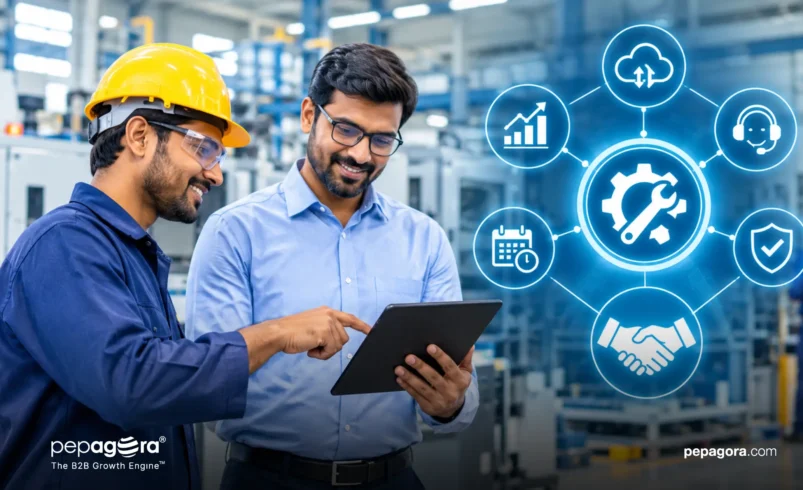

India’s manufacturing MSMEs may be approaching a significant shift in how they sell products and generate revenue. Instead of limiting transactions to the sale of machinery, equipment or industrial products, businesses are increasingly exploring models in which customers pay for access, usage or measurable outcomes.
Known as Product-as-a-Service (PaaS), the model combines physical products with services such as installation, maintenance, monitoring and technical support. In some arrangements, customers pay a monthly subscription or a usage-based fee rather than purchasing the equipment outright. In others, payments are linked to performance or savings delivered by the product.
The approach could create new opportunities for Indian MSMEs, particularly those serving manufacturing, energy, infrastructure, healthcare and industrial supply chains.
Manufacturing Moves Towards Service-Based Models
The shift towards service-led manufacturing has received recognition in India’s policy discussions. NITI Aayog’s October 2025 report, Reimagining Manufacturing: India’s Roadmap to Global Leadership in Advanced Manufacturing, identifies the servicification of manufacturing as a future growth opportunity.
The report describes a transition in which manufacturers move beyond producing physical goods to offering integrated solutions. These may include research and development, engineering, installation, aftermarket support, remote monitoring and performance guarantees. Revenue can increasingly come from recurring arrangements such as subscriptions, pay-per-use and outcome-based contracts.
The roadmap places this transformation in its proposed second phase, covering FY2029 to FY2031. It also identifies technologies such as the Internet of Things (IoT), digital twins, artificial intelligence and predictive analytics as important enablers.
For MSMEs, the development signals a potential change in their position within industrial supply chains. A machinery manufacturer, for instance, could move from selling equipment to offering machine availability, production monitoring and maintenance as a combined service.
Businesses can also understand how smart manufacturing and AI are transforming Indian SMEs as technology becomes an important part of service-based industrial operations.
Pay-Per-Use Models Could Reduce Customer Investment Barriers
One of the key attractions of Product-as-a-Service is that customers may not need to make a large upfront investment to access expensive equipment.
This is particularly relevant for smaller manufacturers that need advanced machinery but face capital constraints. Under a pay-per-use arrangement, a customer pays according to machine hours, output or another agreed usage measure. Equipment providers can retain ownership while generating revenue through continued usage and service agreements.
A March 2025 industry report on machine-tool financing noted that leasing and pay-per-use options were gaining attention among Indian MSMEs as alternatives to outright machinery purchases. Such models can help businesses preserve working capital and access equipment that might otherwise be financially difficult to acquire.
The opportunity is not limited to machinery. Industrial refrigeration, compressed-air systems, water treatment equipment, printing solutions and energy-efficient technologies could also support service-based arrangements.
Businesses can explore subscription models for MSMEs and recurring revenue opportunities to understand how regular service agreements can complement traditional product sales.
Energy Services Offer a Practical Example
India’s green transition provides another example of how product ownership and service delivery can be separated.
NITI Aayog’s January 2026 Roadmap for Green Transition of MSMEs discusses the Energy Service Company (ESCO) model and the Pay-As-You-Save (PAYS) approach. Under this arrangement, an ESCO can finance and implement energy-efficient equipment upgrades at an MSME facility. Instead of bearing the entire upfront cost, the enterprise makes payments linked to the savings generated through reduced energy consumption.
The model can include equipment supply, installation, performance monitoring and after-sales support. It demonstrates how businesses can sell a measurable outcome—in this case, energy savings—rather than simply selling equipment.
However, the roadmap also identifies barriers, including concerns about MSME creditworthiness, limited technical expertise, inadequate energy-consumption benchmarks and reluctance among equipment providers to offer performance guarantees. These challenges highlight the importance of reliable measurement and clear service agreements.
For manufacturers considering this approach, energy efficiency in SMEs also highlights how efficient equipment and improved energy management can reduce operating costs.
Technology and Financing Will Shape Adoption
For MSMEs, moving towards Product-as-a-Service requires more than changing the pricing structure. Businesses must be prepared to manage equipment throughout its operating life, maintain service networks, track usage and respond to customer requirements.
Digital tools can support this transition. IoT-enabled sensors can monitor machine performance, while cloud-based systems can record usage, schedule maintenance and generate service reports. These capabilities can help providers calculate payments, identify operational problems and demonstrate whether agreed outcomes are being delivered.
Financing will also remain important because businesses offering PaaS may need to retain ownership of equipment and recover their investment over several years. The government’s March 2026 modifications to the Mutual Credit Guarantee Scheme for MSMEs, including the extension of eligibility to service-sector enterprises, may improve access to equipment-related credit for eligible businesses.
MSMEs looking to modernise their production facilities can also consider funding factory automation through MSME subsidies.
From Product Suppliers to Solution Providers
Product-as-a-Service is unlikely to replace conventional product sales across India’s MSME sector. Many buyers will continue to prefer outright ownership, particularly when equipment is relatively inexpensive or used for long periods.
However, the model creates an additional route for businesses that can offer dependable products alongside measurable services. It can also strengthen customer relationships through ongoing engagement and create revenue opportunities beyond the initial transaction.
As India’s manufacturing ecosystem moves towards more technology-enabled and service-oriented operations, MSMEs that develop the capabilities to deliver reliable outcomes may find new ways to differentiate themselves. The long-term opportunity lies not simply in selling a machine or product, but in helping customers achieve better productivity, lower operating costs and greater operational reliability.
FAQs
Product-as-a-Service is a business model in which MSMEs provide products along with services such as installation, maintenance and monitoring. Customers pay through subscriptions, usage-based charges or performance-linked agreements instead of purchasing equipment outright.
PaaS can help manufacturers generate recurring revenue, build long-term customer relationships and offer additional services. It can also help customers access expensive equipment without making large upfront investments.
Industries such as manufacturing, energy, healthcare, industrial machinery, water treatment, refrigeration and compressed-air systems can benefit from PaaS through equipment leasing, maintenance contracts, usage-based payments and performance-linked services.
