

India’s Union Budget 2026–27, presented by Finance Minister Nirmala Sitharaman, has reinforced the government’s strong commitment to manufacturing, MSME growth, infrastructure expansion, and export competitiveness.
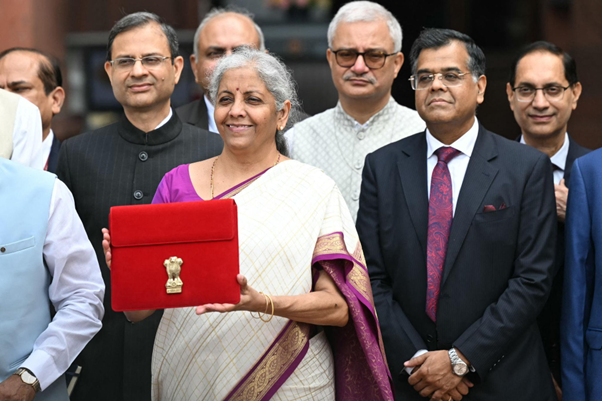
While the Budget does not introduce a packaging-specific scheme, the sector stands to benefit significantly from broader industrial allocations, especially the record ₹12.2 lakh crore capital expenditure (Capex) plan for FY 2026–27.
For India’s rapidly expanding packaging and printing industry, which supports FMCG, pharmaceuticals, e-commerce, electronics, food processing, and exports, the announcements create a positive long-term outlook.
₹12.2 Lakh Crore Capex: Why It Matters for Packaging & Printing
The increased capital expenditure is directed toward:
- Infrastructure development
- Industrial corridors
- Railways and ports
- Logistics modernisation
For the packaging and printing sector, this is significant because industrial growth directly increases demand for:
- Corrugated boxes
- Printed cartons
- Flexible packaging
- Labels and barcoding
- Export-grade packaging
As manufacturing output expands, packaging consumption naturally rises. Improved logistics also reduces transportation costs for paperboard, inks, films, and finished goods.
According to industry coverage, infrastructure remains the central pillar of Budget 2026, reinforcing long-term industrial growth.
₹10,000 Crore MSME Growth Fund: A Direct Positive for Printing Units
A major announcement in Budget 2026 is the ₹10,000 crore MSME Growth Fund, aimed at supporting Micro, Small and Medium Enterprises in scaling operations, improving competitiveness, and adopting technology.
Many packaging converters and printing presses in India operate under the MSME category. Access to structured funding and improved liquidity can support:
- Machinery upgrades
- Automation investments
- Sustainable packaging innovations
- Working capital management
The fund was announced as part of the government’s strategy to strengthen domestic manufacturing and protect MSMEs from global trade volatility.
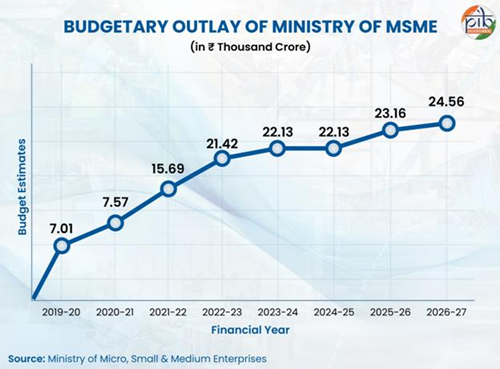
Improved credit access and equity support could allow smaller packaging manufacturers to modernize machinery, invest in sustainable solutions, and compete with larger organized players.
Additionally, measures to strengthen invoice discounting platforms like TReDS are expected to ease liquidity pressure, a long-standing issue in the printing industry.
Manufacturing Momentum Supports Packaging Demand
Budget 2026 continues India’s broader strategy to strengthen manufacturing under long-term economic reforms. As sectors such as:
- FMCG
- Pharmaceuticals
- Food processing
- Electronics
- E-commerce
expand production, demand for primary and secondary packaging increases proportionally.
The government’s manufacturing-led growth roadmap is expected to improve supply chain stability and encourage domestic production that benefits allied industries like packaging and printing.
Logistics & Container Manufacturing Scheme: Cost Efficiency Gains
The Budget also announced a container manufacturing initiative with a ₹10,000 crore allocation over five years.
This move aims to reduce dependency on imported containers and strengthen India’s export logistics ecosystem.
For packaging businesses, the impact is twofold:
- Export-oriented packaging manufacturers benefit from smoother shipment availability.
- Reduced logistics bottlenecks can stabilize freight costs, improving profit margins.
Improved port connectivity, freight corridors, and multimodal logistics hubs will help reduce turnaround time, a key factor for FMCG and pharma packaging suppliers.
Manufacturing Push: A Long-Term Growth Signal
India’s manufacturing sector continues to be a priority under the government’s long-term economic roadmap.
The consistent focus on “Make in India,” domestic production incentives, and industrial expansion creates a multiplier effect across allied sectors including packaging.
Packaging is not just a support industry; it is a value-addition driver.
As sectors like pharmaceuticals, food processing, personal care, and electronics scale production, demand for:
- High-quality printed cartons
- Tamper-proof labels
- Flexible pouches
- Sustainable packaging materials
- Smart and QR-enabled labels
will increase.
The Budget’s growth-oriented tone indicates that packaging companies aligned with high-growth sectors could see strong order inflows over the next 2–3 years.
Sustainability & Green Packaging: Growing Policy Momentum
Although Budget 2026 did not introduce a direct subsidy for green packaging, sustainability remains central to India’s industrial transformation.
With Extended Producer Responsibility (EPR) norms and plastic waste regulations already active, packaging manufacturers are expected to invest in:
- Recyclable mono-material packaging
- Compostable materials
- Paper-based alternatives
- Low-ink and eco-friendly printing solutions
Government emphasis on sustainable manufacturing and circular economy practices indirectly pushes packaging companies toward innovation.
Businesses that invest early in sustainable packaging technologies may gain an advantage in export markets and large retail contracts.
Export-Driven Growth: Opportunities for Packaging Suppliers
India’s continued push toward export competitiveness also benefits the packaging sector.
As exporters scale operations, demand for:
- Export-grade corrugated boxes
- Moisture-resistant packaging
- International labeling compliance printing
- Barcode and traceability solutions
is expected to grow.
The removal of certain export bottlenecks and improvement in logistics efficiency will make Indian packaging suppliers more competitive globally.
Most Searched Industry Concerns Addressed by Budget 2026
Based on common industry queries and business concerns, here’s how Budget 2026 responds:
1. Will packaging raw material costs reduce?
While no direct tax cut was announced specifically for paper or plastic raw materials, logistics efficiency and domestic manufacturing support may stabilize supply chains and input pricing over time.
2. Will printing businesses get easier loans?
Yes. MSME credit expansion and growth funds are expected to improve financing access for printing presses and packaging converters.
3. Does Budget 2026 support packaging exports?
Indirectly, yes. Export facilitation, container manufacturing, and logistics modernization support export-oriented packaging businesses.
4. Is there a direct subsidy for packaging?
No direct packaging-specific subsidy was announced. However, the broader manufacturing ecosystem benefits strongly.
Industry Outlook for 2026–27
The Indian packaging industry has been growing steadily, supported by:
- E-commerce expansion
- Pharmaceutical exports
- FMCG growth
- Organized retail penetration
- Rising rural consumption
Budget 2026 strengthens the macroeconomic foundation needed for this growth to continue.
Experts suggest that while immediate direct incentives are limited, the policy direction clearly supports industrial expansion, which is fundamentally positive for packaging and printing businesses.
Strategic Recommendations for Packaging Businesses
To maximize Budget-driven opportunities, packaging firms should:
- Leverage MSME funding schemes for automation and technology upgrades
- Focus on sustainable packaging innovations
- Strengthen export compliance capabilities
- Invest in digital printing and short-run customization
- Improve working capital management using invoice discounting platforms
Companies that align early with infrastructure and export growth trends may capture larger market share in FY 2026–27.
A Structural Growth Opportunity for Packaging & Printing
Union Budget 2026–27 positions infrastructure and MSMEs at the core of India’s economic strategy.
While the packaging and printing sector did not receive a dedicated scheme, the macroeconomic drivers supporting it have been significantly strengthened.
The ₹12.2 lakh crore capital expenditure plan and ₹10,000 crore MSME Growth Fund create a stable foundation for manufacturing expansion.
For packaging businesses, the opportunity lies not in waiting for sector-specific incentives but in aligning early with India’s infrastructure-led and export-driven growth cycle.
Companies that invest in modernization, sustainability, and logistics efficiency are likely to benefit most from the policy direction set in Budget 2026–27.