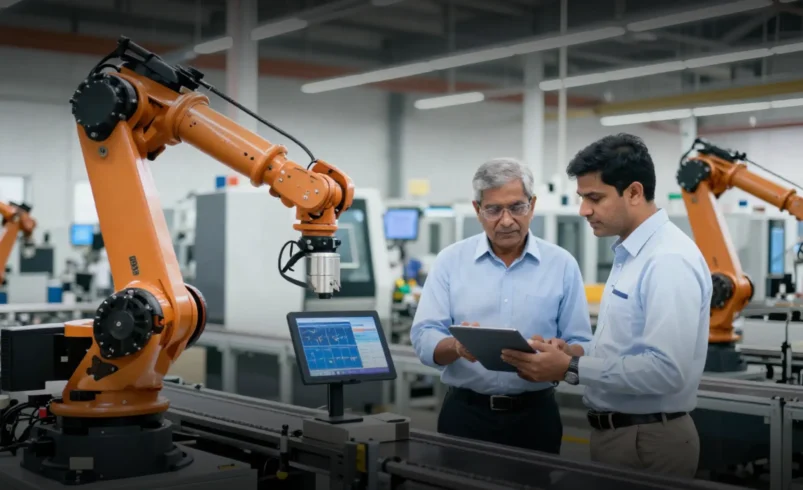

COIMBATORE — For decades, small-scale manufacturers across India’s industrial corridors have faced a daunting bottleneck: the staggering cost of upgrading legacy machinery. While large conglomerates easily transition to Industry 4.0 automation, Internet of Things (IoT) sensors, and advanced robotics, micro and small enterprises (MSEs) are routinely left behind, trapped by the high capital expenditure required for technological modernization.
However, a quiet shift is underway. Forward-thinking small business owners are tapping into revitalized central government subsidies—specifically the MSME Sustainable (ZED) Certification Scheme and the MSME Competitive (Lean) Scheme—to fundamentally restructure their factory floors at a fraction of the market cost. These initiatives are also accelerating smart manufacturing adoption among SMEs seeking greater efficiency and competitiveness.
The Cost of Staying Old
In clusters like Coimbatore, Indore, and Ludhiana, running outdated machinery is no longer just a minor inefficiency—it is an existential threat to survival. Legacy equipment consumes more electricity, suffers frequent breakdowns, and generates higher rejection rates. With global supply chains demanding stricter quality benchmarks and razor-thin margins, manual tracking and obsolete tools are draining SME profits.
“We knew we needed to automate our CNC shop floor with real-time data tracking, but the initial vendor quotes were enough to stall our plans for years,” says a tier-2 automotive component supplier. “The breakthrough happened when we realized the government would foot a massive portion of the implementation bill.”
The Subsidy Engine: ZED and Lean Schemes
To bridge this technology gap, the Ministry of MSME has restructured its flagship programs to offer direct financial relief rather than just theoretical training:
The ZED (Zero Defect Zero Effect) Boost
This scheme provides direct financial relief for certification and consulting. According to the MSME Ministry, micro enterprises receive 80% subsidy on the cost of ZED certification under the ZED Scheme. More importantly, joining the ZED journey unlocks targeted financial support for upgrading manufacturing processes to reduce waste and eliminate defects.
Lean Manufacturing Subsidies
Under the Lean Scheme, the government subsidizes up to 90% of the consultant fees required to implement modern manufacturing philosophies like Kaizen, 5S, and Just-In-Time (JIT). These consultants help factories integrate low-cost digital tools, handheld scanners, and automated inventory systems.
Capital Subsidies and Bank Incentives
Many state governments and public sector banks offer an additional 5% to 15% capital subsidy on the purchase of specialized, energy-efficient automated machinery if the business holds a valid Udyam and ZED certificate.
Overcoming the “Paperwork” Fear
The primary reason these millions of rupees in subsidies go unclaimed is the deeply ingrained fear of bureaucratic red tape among SME owners. Many assume the application process requires endless physical documentation and bribes.
In reality, the Ministry has migrated these portals onto completely paperless, digital dashboards. Applications for schemes like ZED or Lean are tied directly to an owner’s Udyam registration number, allowing automated verification. The funds or fee waivers are disbursed via Direct Benefit Transfer (DBT) or credited directly to verified consulting agencies, cutting out middlemen entirely.
The Competitive Edge
As large global buyers increasingly audit Indian suppliers for sustainability and digital tracking capabilities, tech upgrades are no longer a luxury. By leveraging government-backed subsidies to offset up to 90% of optimization costs, Indian SMEs can finally afford to automate their operations, slash production defects, and compete on equal footing with international manufacturers.
For manufacturers looking to expand beyond domestic markets after modernizing their operations, leveraging a global b2b marketplace can help unlock new sourcing opportunities, connect with international buyers, and drive export growth.