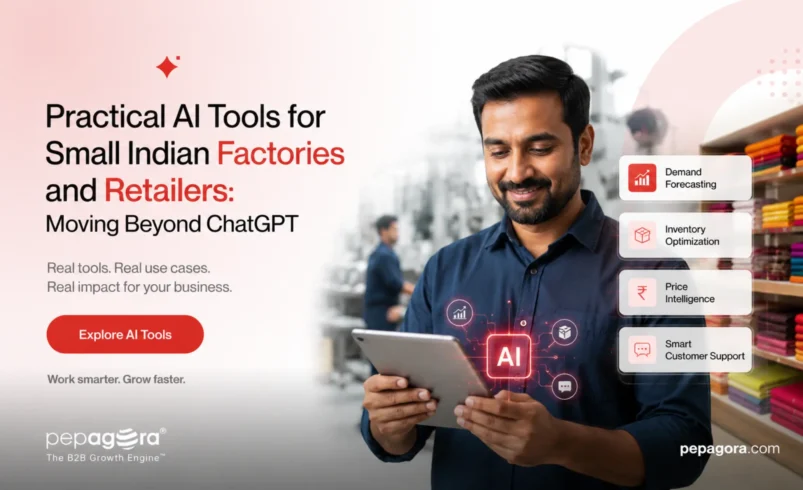

Artificial Intelligence is no longer limited to large corporations or advanced tech teams.Today, small factories, distributors, and retail businesses in India can use affordable AI tools to improve efficiency, reduce costs, and increase sales. The shift is no longer about “whether AI is useful,” but “which practical AI tools can be implemented quickly without heavy investment.” Recent market shifts highlight how Indian businesses are turning AI into profit by shifting their focus from generic technology trends toward direct operational value.
From inventory prediction to regional language customer support and automated billing systems, AI is becoming a real operational tool for SMEs rather than just a digital buzzword.
Why AI Adoption Is Becoming Necessary for Indian SMEs
Indian SMEs operate in highly competitive and margin-sensitive environments. Common challenges include:
Unpredictable demand cycles
Overstocking or stockouts
Manual billing errors
High dependency on human customer support
Limited staff for backend operations
Difficulty handling multilingual customers
Affordable AI tools are now addressing these exact problems without requiring advanced technical knowledge or large IT budgets.
AI for Inventory Prediction: Reducing Stock Loss and Improving Cash Flow
One of the most practical AI applications for SMEs is demand forecasting and inventory optimization. Modern tools analyze:
Past sales data
Seasonal demand patterns
Market trends
Local events and festivals
Customer purchasing behavior
This helps businesses:
Avoid overstocking slow-moving items
Prevent stockouts during high demand
Optimize procurement cycles
Improve working capital management
SMEs can use tools like Google Sheets AI add-ons, Zoho Inventory with prediction features, Shopify inventory forecasting apps, and Tally-integrated AI plugins. Even basic AI-driven forecasting can reduce inventory inefficiency by 15–30% in small retail and manufacturing setups.
AI-Powered Customer Support in Regional Languages
India’s biggest SME advantage is also its biggest challenge: linguistic diversity. AI-powered customer support tools now allow businesses to handle queries in Hindi, Tamil, Telugu, Bengali, Marathi, Kannada, Malayalam, and Gujarati.
This is done using:
AI chatbots
WhatsApp automation tools
Voice-based assistants
Multilingual CRM systems
Practical tools used by SMEs include WATI (WhatsApp automation), Freshchat AI, Zoho Desk AI, Google Business messaging tools, and AI voice bots for inbound calls.
Benefits include:
24/7 customer support without hiring staff
Faster response time
Reduced dependency on call centers
Better customer satisfaction
Higher conversion rates from inquiries
For many SMEs, AI chatbots now handle 60–80% of basic customer queries.
AI in Billing and Accounting Automation
Manual billing and bookkeeping remain major pain points for small businesses. AI is now simplifying these processes significantly. Modern billing systems can:
Automatically generate invoices
Track GST compliance
Reconcile payments
Send payment reminders
Categorize expenses
Generate financial summaries
Popular tools used by Indian SMEs include Tally Prime with AI integrations, Zoho Books, Vyapar App, QuickBooks India, and Marg ERP. AI reduces human errors in billing, time spent on bookkeeping, delays in invoice generation, and compliance issues, allowing business owners to focus more on operations and growth rather than paperwork.
Moving Beyond ChatGPT: Operational AI vs Content AI
While tools like ChatGPT are useful for writing and communication, SMEs are now shifting toward operational AI tools that directly impact business performance.
The difference:
ChatGPT: Content creation, ideas, communication
Operational AI: Inventory, billing, sales, customer service
SMEs benefit more from tools that integrate with business systems, automate repetitive workflows, and connect directly with sales and accounting data.
Low-Cost AI Stack for Small Businesses
A practical AI stack for SMEs in India may include:
Inventory: Zoho Inventory / Google Sheets AI
Customer support: WhatsApp AI bots (WATI, Interakt)
Billing: Vyapar / Tally AI tools
Marketing automation: Mailchimp AI / Zoho Campaigns
Analytics: Google Analytics AI insights
Most of these tools are available on monthly subscriptions starting at very low costs, making them accessible even for micro-enterprises.
Key Benefits of AI Adoption for SMEs
When implemented correctly, AI tools deliver measurable impact:
20–40% reduction in operational workload
Improved inventory accuracy
Faster customer response times
Better cash flow management
Reduced staffing pressure
Higher customer retention
AI does not replace employees in SMEs; it enhances productivity and reduces repetitive workload.
Challenges in Adoption
Despite clear benefits, many SMEs still hesitate due to lack of awareness, fear of complexity, resistance to digital change, limited training, and budget concerns. However, most modern AI tools are designed specifically for non-technical users with simple dashboards and plug-and-play setup.
Future Outlook
In the next 3–5 years, AI will become a standard part of SME operations in India.Businesses that adopt early will gain competitive advantages in efficiency, cost control, and customer engagement. For manufacturing setups and small factories, embracing smart manufacturing and AI solutions will become a defining factor between growth-oriented enterprises and those struggling to keep pace with changing market dynamics.
The biggest shift will not be technology-driven alone, but behavior-driven—SMEs will increasingly rely on AI to manage routine decisions while focusing human effort on strategy and relationships.

About Author
Harsha Varthan
Harsha is a highly respected B2B marketing expert who passionately helps sellers and buyers connect, grow their businesses online, and build strong global visibility. His expertise spans SEO, content marketing, lead generation, marketplace strategy, public relations, and result-driven digital growth planning, making him a trusted voice in the industry.