
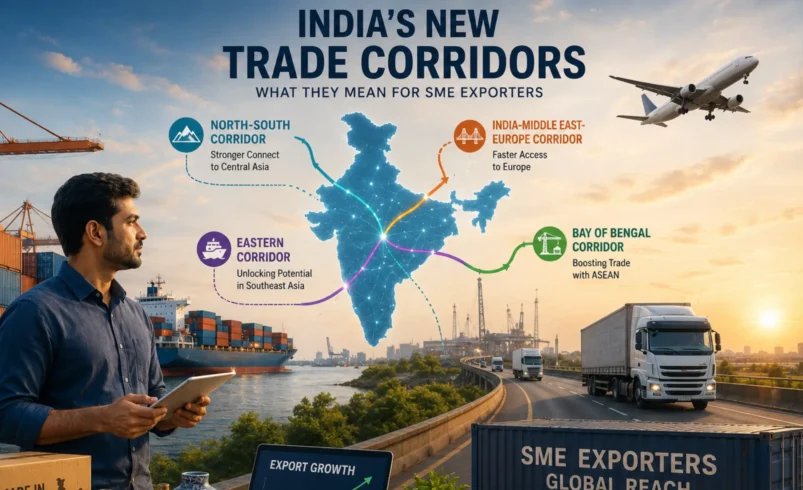

India’s export ecosystem is entering a new phase of transformation. With major investments in ports, freight corridors, multimodal logistics networks, and international trade routes, the country is creating new pathways that could significantly benefit small and medium enterprises (SMEs) looking to expand globally.
While large corporations have traditionally been the biggest beneficiaries of international trade infrastructure, industry experts believe that India’s emerging trade corridors could help level the playing field for SME exporters by reducing logistics costs, improving delivery timelines, and opening access to new overseas markets.
A Strategic Shift in India’s Trade Infrastructure
Over the past few years, India has accelerated investments in transport and logistics infrastructure. Projects such as the Dedicated Freight Corridors, industrial corridors, modernized ports, multimodal logistics parks, and enhanced connectivity to neighboring countries are reshaping the movement of goods across the country.
The government’s focus is clear: reduce logistics costs, improve supply chain efficiency, and strengthen India’s position as a global manufacturing and export hub.
For SMEs, these developments are particularly important because logistics expenses often represent a larger percentage of overall costs compared to larger enterprises. Industry analysts estimate that logistics costs in India have historically ranged between 13% and 14% of GDP, significantly higher than many developed economies. Improved trade corridors are expected to gradually bring these costs down, improving competitiveness for exporters of all sizes.
New Routes, New Opportunities
The expansion of trade corridors is creating easier access to key export destinations across the Middle East, Europe, Southeast Asia, and Africa.
Several emerging routes are attracting attention:
- India-Middle East-Europe connectivity initiatives
- Enhanced shipping routes to GCC countries
- Faster access to Southeast Asian markets
- Improved multimodal links connecting manufacturing clusters to ports
- Dedicated freight infrastructure linking industrial regions with export gateways
For SME exporters, this means shorter transit times and potentially lower shipping expenses. A manufacturer in Coimbatore, Rajkot, Ludhiana, Surat, or Jaipur may soon be able to move products to international buyers more efficiently than ever before.
Why SMEs Should Pay Attention
Many small businesses view exporting as complex and expensive. However, improved trade corridors are addressing some of the most common barriers.
- Reduced Transportation Costs: Better rail connectivity, improved highways, and modern logistics hubs can help reduce transportation expenses. Lower logistics costs improve profit margins and allow SMEs to offer more competitive pricing in international markets.
- Faster Delivery Times: Global buyers increasingly prioritize reliability and speed. Enhanced trade routes can shorten delivery schedules, helping Indian exporters compete more effectively against suppliers from other countries.
- Access to New Markets: As connectivity improves, SMEs may find it easier to explore buyers in regions that were previously difficult or expensive to serve. The Gulf region, Africa, Eastern Europe, and Southeast Asia are increasingly being viewed as promising growth markets for Indian exporters.
- Improved Supply Chain Reliability: Supply chain disruptions have become a major concern for businesses worldwide. New trade corridors help diversify transportation options and reduce dependence on single routes, improving resilience and reliability.
Manufacturing Clusters Stand to Gain
India’s industrial clusters are expected to be among the biggest beneficiaries of the country’s logistics transformation. Manufacturing hubs specializing in:
- Engineering products
- Chemicals
- Textiles
- Automotive components
- Consumer goods
- Agricultural products
- Pharmaceuticals
could experience stronger export growth as connectivity improves. Industry observers believe that many Tier-2 and Tier-3 cities may become increasingly important contributors to India’s export performance over the next decade.
Global Buyers Are Looking Beyond Traditional Suppliers
International sourcing patterns are changing. Businesses across Europe, North America, and the Middle East are actively seeking to diversify supply chains and reduce dependence on a limited number of sourcing destinations.
India is emerging as a preferred alternative due to its manufacturing capabilities, skilled workforce, and growing infrastructure investments. For SMEs, this presents a unique opportunity. Companies that invest in quality standards, export readiness, and digital visibility may be well-positioned to capture new international demand.
The Digital Opportunity
Infrastructure alone is not enough. Even with improved trade corridors, buyers must first be able to discover suppliers.
This is why many SMEs are increasingly investing in digital visibility, online product catalogs, verified business profiles, and B2B sourcing platforms. Export experts note that global buyers often begin their supplier search online long before initiating direct conversations. Businesses that combine strong logistics access with a visible digital presence are likely to have a competitive advantage in the coming years.
Challenges Still Remain
While the outlook is promising, SMEs must continue addressing several structural hurdles and rising logistics costs:
- Export compliance requirements
- Product certifications
- International quality standards
- Payment security
- Foreign currency management
- Market-specific regulations
Industry bodies are encouraging small businesses to strengthen export capabilities while taking advantage of the infrastructure improvements now being rolled out across the country.
Looking Ahead
India’s new trade corridors represent more than just transportation projects. They are part of a broader effort to make the country a stronger participant in global trade.
For SMEs, the implications could be significant. Lower logistics costs, faster deliveries, better connectivity, and access to emerging markets have the potential to unlock growth opportunities that were previously out of reach. As global supply chains continue to evolve, India’s expanding trade infrastructure may help thousands of small businesses move from serving local markets to competing on the international stage.
For export-ready SMEs, the message is becoming increasingly clear: the pathways to global markets are getting wider, faster, and more accessible than ever before.
