
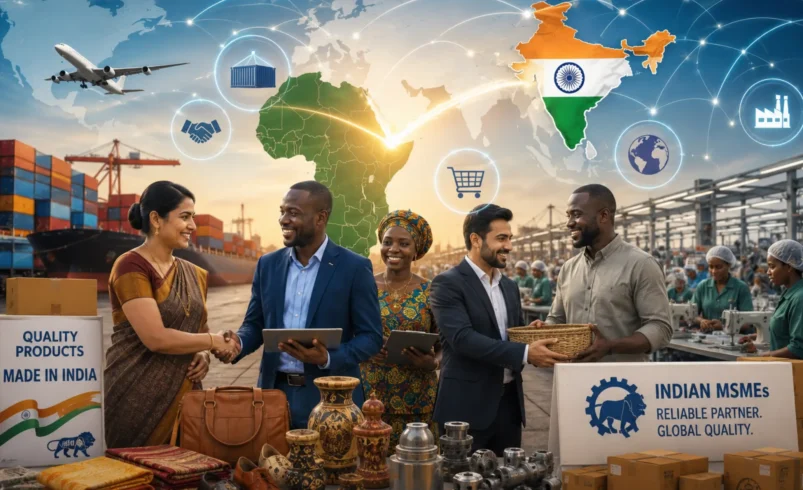

As global supply chains continue to evolve, Indian Micro, Small, and Medium Enterprises (MSMEs) are finding new opportunities in Africa, a continent increasingly viewed as one of the world’s fastest-growing trade destinations. With international buyers seeking alternatives to traditional sourcing markets, Indian exporters are steadily expanding their presence across emerging markets in Africa, creating new growth avenues for businesses of all sizes.
Industry experts believe that Africa could become one of the most important export destinations for Indian MSMEs over the next decade, driven by rising consumer demand, rapid urbanization, infrastructure development, and growing industrialization across the continent.
Global Supply Chains Are Shifting
The last few years have witnessed significant changes in global sourcing strategies. Geopolitical uncertainties, severe shipping disruptions, rising production costs in some regions, and a growing focus on supply chain resilience have encouraged buyers to diversify their supplier base.
Instead of relying heavily on a limited number of sourcing destinations, international procurement teams are actively exploring new markets that can offer competitive pricing, manufacturing capabilities, and reliable delivery. India has emerged as one of the key beneficiaries of this shift. At the same time, African countries are increasingly looking toward India for products ranging from engineering goods and pharmaceuticals to agricultural products, chemicals, textiles, machinery, and consumer goods.
Why Africa Matters for Indian MSMEs
Africa is home to more than 1.4 billion people and is expected to account for a significant share of global population growth over the coming decades. Several factors are making the continent increasingly attractive for Indian exporters:
- Growing middle-class population
- Rapid urban development
- Expanding manufacturing activities
- Rising demand for affordable products
- Infrastructure investments
- Strong economic growth in several regions
Many African economies are investing heavily in transportation networks, housing projects, healthcare infrastructure, energy development, and industrial production, creating demand for imported goods and industrial supplies. For companies looking to expand their footprints beyond overcrowded corridors, exploring alternative markets in Africa has become a highly strategic business move.
Engineering and Industrial Products Lead the Way
One of the strongest areas of growth has been engineering and industrial exports. African buyers are increasingly sourcing:
- Industrial machinery
- Electrical equipment
- Construction materials
- Auto components
- Industrial chemicals and raw materials
- Manufacturing equipment
Indian manufacturers have gained attention due to their ability to offer quality products at competitive prices. Industry observers note that many buyers view Indian suppliers as capable of delivering a balance between affordability and quality, making them attractive partners for businesses across the continent.
Pharmaceutical Exports Continue to Expand
Healthcare remains another major area of opportunity. As African countries work to improve healthcare access and infrastructure, demand for pharmaceutical products, medical equipment, and healthcare supplies continues to increase.
Indian pharmaceutical manufacturers have established a strong reputation in several African markets, creating additional opportunities for supporting industries and SME suppliers within the healthcare value chain.
Agricultural and Food Products Finding New Markets
Agriculture continues to play a central role in many African economies. Indian exporters are seeing growing demand for:
- Food products
- Agricultural machinery
- Irrigation equipment
- Fertilizers
- Agrochemicals
- Food processing machinery
The increasing focus on food security and agricultural productivity across Africa is creating opportunities for Indian businesses specializing in agricultural solutions.
The African Continental Free Trade Area Creates Momentum
The implementation of the African Continental Free Trade Area (AfCFTA) is expected to further accelerate trade and economic integration across the continent. The initiative aims to create one of the world’s largest free trade areas, making it easier for businesses to access multiple markets within Africa.
For Indian exporters, this could translate into larger market opportunities and improved regional distribution networks. Export consultants believe that businesses entering Africa today may be better positioned to benefit from future trade expansion across the continent.
Digital Trade Is Helping SMEs Reach New Buyers
Historically, many MSMEs struggled to enter international markets because they lacked overseas networks and market visibility. Digital transformation is changing that equation. Today, international buyers often begin supplier discovery online.
Businesses that maintain professional digital profiles, showcase product catalogs, highlight certifications, and respond quickly to inquiries are increasingly attracting attention from overseas buyers. The rise of digital B2B platforms is helping Indian suppliers become visible to procurement teams that may have previously been difficult to reach. For MSMEs with limited marketing budgets, this represents a significant operational advantage.
Challenges Remain
Despite the opportunities, exporters must navigate several challenges when entering African markets. These include:
- Market-specific regulations
- Product certification requirements
- Payment security considerations
- Logistics planning
- Local distribution networks
- Understanding buyer preferences
Trade experts recommend conducting thorough market research and carefully evaluating hidden sourcing costs rather than focusing solely on short-term transactions. Businesses that invest in understanding local market dynamics are generally more successful in establishing sustainable export operations.
SMEs from Smaller Cities Are Participating
One notable trend is the growing participation of businesses from Tier-2 and Tier-3 cities. Manufacturers and exporters from industrial hubs such as Coimbatore, Rajkot, Surat, Indore, Ludhiana, Morbi, and Jaipur are increasingly exploring opportunities in African markets.
Improved logistics infrastructure, digital connectivity, and access to online trade platforms are enabling smaller businesses to compete globally without maintaining a physical presence overseas. This is helping democratize export opportunities across India’s broader MSME ecosystem.
A Long-Term Growth Story
Africa’s economic transformation is still in its early stages. Many analysts believe the continent could become one of the most significant drivers of global economic growth over the next two decades.
For Indian MSMEs, the opportunity extends beyond exports alone. It includes long-term partnerships, distribution agreements, technology collaboration, and participation in emerging value chains. As global buyers continue diversifying sourcing strategies and African economies continue expanding, Indian businesses are increasingly well-positioned to strengthen their presence across the continent.
The message for MSMEs is clear: Africa is no longer just an emerging market. It is becoming a strategic growth destination, and Indian exporters that move early may gain a significant competitive advantage in the years ahead.
