
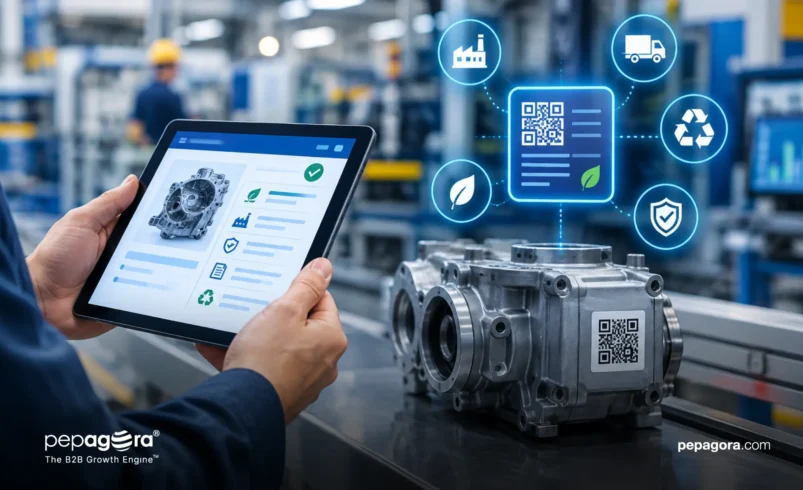

The manufacturing process is also becoming more data-oriented. data-oriented Customers will be curious about the source of production, material used, process of production, and if their products are compliant with the regulations and sustainability criteria.
This is where the concept of Digital Product Passport (DPP) can come handy. A DPP would be nothing but an electronic documentation of the data related to the product and its life cycle. As per the Ecodesign for Sustainable Products Regulation of European Union, there are plans to develop Digital Product Passports.
This can change everything for manufacturers and B2B companies.
What Is a Digital Product Passport?
A Digital Product Passport links the actual product to the digital information through a digital carrier, for instance, through a QR code or some other machine-readable form.
Based on the specific product or regulations, this may comprise product identification, manufacturer details, compliance records, technical data, instructions or any other relevant information. In addition, DPP data should be in interoperable machine-readable formats under the EU’s scheme.
Rather than depending on various documents, emails, and spreadsheets, businesses would be able to share all the relevant information about their products in one single digital file.
Improved Traceability Within Manufacturing
Often, there are several suppliers and components that manufacturers use. It is hard to track all of this information manually, particularly when the process involves crossing of borders.
The DPPs would improve traceability of all the information within the entire value chain. Buyers, distributors, repairers, recyclers and other authorized parties would have access to all the necessary information based on their permissions.
For manufacturers, improved traceability would allow them to easily determine the origin of the material and components, as well as the final products.
Improved Compliance for International Business
Compliance requirements are becoming an important part of international business-to-business trade. international business-to-business trade Companies selling into regulated markets would need to provide more detailed information about their products.
EU’s DPP system was created to enable verification of compliance and traceability of the processes. The European Commission created the DPP Registry back in July 2026 with the idea to register the product identifiers and the necessary metadata about the products which fall under the relevant legislation.
For exporters, it will be very important to provide the necessary product data.
Increased Trust Between B2B Buyers and Suppliers
It is essential for B2B buyers to be sure before getting into long-term relationships with suppliers. Unverifiable information about the characteristics of the product causes ambiguity.
A digital passport that would allow to consistently deliver information about the characteristics, compliance, and other parameters of the product would allow suppliers to demonstrate their reliability.
Small manufacturers that do not possess the reputation of big brands will benefit from such passports when entering the international market.
Opportunities for Circular Manufacturing
DPPs are also tightly linked with the trend towards increased circularity in manufacturing.
Data about the material, reparability, reuse, refurbishment, and recycling of the product provides business opportunities beyond the product sale.
This allows manufacturers and downstream enterprises to gain an understanding of what should be done with the product at the end of its lifecycle.
For manufacturers, it means an opportunity to go further than just the manufacturing and selling of the product.
Improved Data Exchange in Business-to-Business Supply Chains
Another possible significant change would be how companies share product information.
Rather than requesting repeatedly technical information, certifications, and other product information from suppliers, business would get digital structured information via interoperable systems. The EU framework focuses on open standards and machine-readable data rather than the reliance on one technology vendor.
This could decrease information asymmetries between manufacturers, suppliers, distributors, and buyers.
How MSMEs Can Prepare
MSMEs do not necessarily have to change their business model overnight. Instead, they can begin by enhancing the quality and organization of their product information.
Companies should think about the following:
- Producing standardized product information
- Digitizing technical documentation
- Keeping up-to-date supplier and material information
- Assigning unique product or batch numbers
- Determining which export destinations will require the introduction of DPP
- Developing mechanisms that will allow the exchange of structured product information
The European Commission advises companies to prepare for future obligations since DPP will be introduced gradually.
Digital Product Passports might bring a paradigm shift in manufacturing processes that move away from information being scattered over various documents to accurate information being attached to the product.
In the case of B2B transactions, there would be increased traceability, compliance, buyer confidence and information exchange. MSMEs which intend to get involved in global supply chain operations would have to consider their preparedness for digital information about each product.
The future of B2B commerce may not just involve what the business manufactures but how well it can validate and manage the information associated with every product.
FAQs
A Digital Product Passport provides digital information about a product, including its materials, manufacturer, and compliance details.
DPP can improve product traceability, data management, compliance, and information sharing across the supply chain.
MSMEs involved in international markets can prepare by organizing product data, digitizing documents, and maintaining accurate supplier and material information.
