


India’s machinery sector is at an inflection point.
With the Union Budget 2026–27, presented on February 1 by Finance Minister Nirmala Sitharaman, the government has doubled down on its decade-long bet to make India a global manufacturing hub.
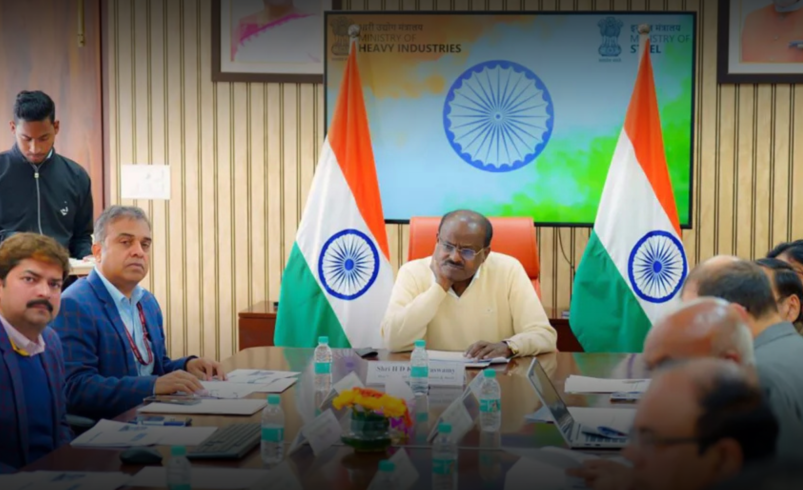
The Ministry of Heavy Industries, currently headed by H. D. Kumaraswamy, will play a central role in overseeing capital goods and industrial manufacturing initiatives linked to these announcements.
For India’s Industrial Equipment & Machinery Manufacturers, this budget is not incremental. It represents a historic reorientation towards domestic production, MSME-led growth, and infrastructure-backed demand that has not been seen in India in over a generation.
Here is everything that changed, and why 2026 marks a turning point for the sector.
₹12.2 Lakh Crore Capex: A 9% Jump from Last Year
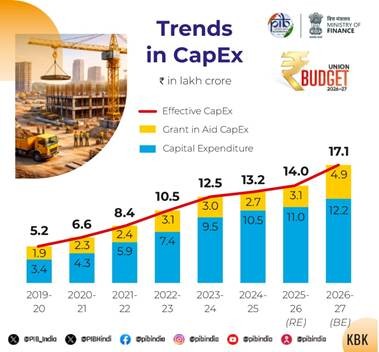
Budget 2026 commits ₹12.2 lakh crore to public capital expenditure in FY 2026–27, an 11.5% increase from ₹10.9 lakh crore in FY 2025–26, as confirmed by Business Standard. FM Sitharaman noted this marks a six-fold increase from just ₹2 lakh crore in FY 2014–15. When you include provisions for states, as reported by The Tribune India, India’s effective capex rises to ₹17.1 lakh crore, or 4.4% of GDP.
This creates sustained demand for heavy machinery, earth-moving equipment, cranes, conveyor systems, railway equipment, industrial compressors, and port handling gear. Railways received nearly ₹3 lakh crore for high-speed corridors and freight expansion, as noted by Free Press Journal. The government is also developing a Dankuni–Surat Dedicated Freight Corridor spanning 2,052 km and operationalizing 20 new National Waterways.
The Domestic Manufacturing Push: From Imports to “Made in India”
Budget 2026 shifts spending decisively toward domestic production. As highlighted by Manufacturing Today India, the government backs seven strategic sectors including electronics, semiconductors, capital goods, and textiles, all focused on building capacity locally.
The India Semiconductor Mission 2.0, with ₹40,000 crore, secures domestic supply of chips used in CNC machines, PLCs, and industrial automation. As India moves toward covering 70–75% of semiconductor requirements by 2029, machinery costs will fall and supply chains will shorten.
Budget 2026 also introduced a Construction and Infrastructure Equipment (CIE) Scheme to boost local manufacturing of tunnel-boring machines, lifts, and industrial equipment.
These capital goods initiatives fall within the broader heavy industries framework overseen by H. D. Kumaraswamy. A Container Manufacturing Scheme targets 1 million TEUs annually, up from 30,000 today, mobilising ₹1.1 lakh crore in investments and creating 50,000 indirect jobs.
101% Jump in MSME Support: The Biggest Winner
The MSME sector is Budget 2026’s standout beneficiary. According to Grant Thornton Bharat, allocation for Development of Village and Small Industries surged from ₹10,073 crore in FY 2025–26 to ₹20,296 crore in FY 2026–27, a 101% increase. Infrastructure support also jumped: MSE-CDP up 28% to ₹410 crore, TCSP up 83% to ₹417 crore, and RAMP up 2% to ₹1,500 crore.
The ₹10,000 crore SME Growth Fund, announced by PIB India, helps MSMEs upgrade equipment and access equity capital. The Self-Reliant India Fund received a ₹2,000 crore top-up for micro enterprises.
For machinery suppliers selling lathes, CNC systems, welding equipment, and industrial tools to MSMEs, this is transformational. As MSMEs modernise and upgrade, machinery demand will surge.
Hi-Tech Tool Rooms and Legacy Cluster Revival
Budget 2026 commits to CPSE-led Hi-Tech Tool Rooms to manufacture precision components domestically, as confirmed by IBEF. These automated service bureaus will produce high-tolerance parts for CNC machines and hydraulic systems, lowering costs and reducing dependence on imports from Germany, Japan, and South Korea.
The Budget also announced the revival of 200 legacy industrial clusters employing 114 million workers and generating 35% of India’s exports. These clusters will receive infrastructure upgrades and technology adoption support, creating a massive replacement market for modern machinery and automation equipment.
The Comparison That Tells the Full Story
Here is what changed between Budget 2025 and Budget 2026 in the machinery-relevant sectors:
Sector | Budget 2025 | Budget 2026 | Change |
Public Capex | ₹11.2 lakh crore | ₹12.2 lakh crore | +9% |
Effective Capex | ₹15.9 lakh crore | ₹17.1 lakh crore | +7.5% |
Village & Small Industries | ₹10,073 crore | ₹20,296 crore | +101% |
MSE-CDP (Cluster Dev) | ₹321 crore | ₹410 crore | +28% |
TCSP (Tech Centres) | ₹228 crore | ₹417 crore | +83% |
PLI Scheme (Mfg boost) | ₹9,362 crore | ₹17,517 crore | +87% |
The data tells a clear story. Budget 2026 is not a marginal adjustment. It is a structural acceleration of India’s manufacturing and infrastructure agenda, with the machinery sector positioned squarely at the centre.

What This Means for Machinery Buyers and Manufacturers
Whether you are procuring industrial lathes, CNC machines, hydraulic presses, material handling systems, or heavy-duty fabrication equipment, the conditions for growth in India have shifted.
More domestic production means stronger competition among suppliers, driving prices down. Better MSME access to capital means more buyers upgrading equipment. A government committing ₹17.1 lakh crore to infrastructure means multi-year, sustained demand for heavy machinery, transport equipment, and industrial systems.
And perhaps most importantly, India’s shift toward self-reliance means the domestic machinery market is no longer just about servicing infrastructure projects. It is about building the entire supply chain at home, from chips and precision parts to finished industrial equipment.

About Author
Harsha Varthan
Harsha is a highly respected B2B marketing expert who passionately helps sellers and buyers connect, grow their businesses online, and build strong global visibility. His expertise spans SEO, content marketing, lead generation, marketplace strategy, public relations, and result-driven digital growth planning, making him a trusted voice in the industry.