
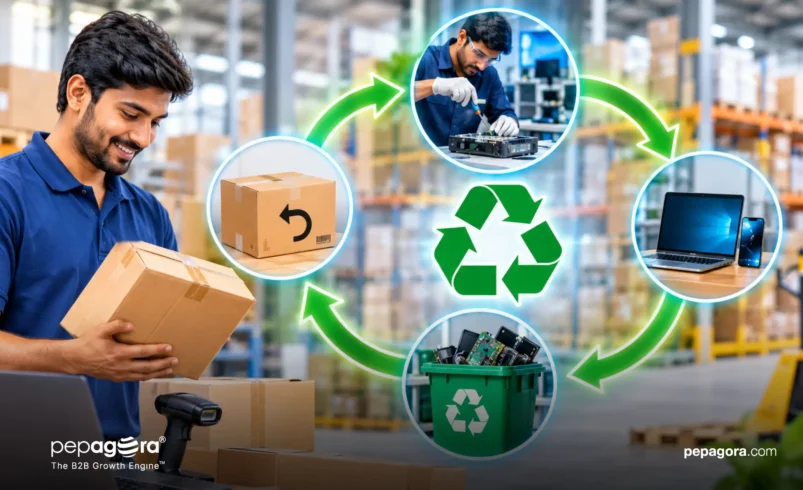

As India’s e-commerce and manufacturing sectors expand, the movement of goods is no longer limited to deliveries from sellers to customers. Returned products, rejected export consignments, damaged goods, used equipment and recyclable materials are creating a parallel supply-chain requirement known as reverse logistics.
For India’s micro, small and medium enterprises (MSMEs), this developing segment presents an opportunity to build businesses around product collection, sorting, repair, refurbishment, recycling and resale. While traditional logistics focuses on moving products towards customers, reverse logistics manages their movement back through the supply chain for recovery, reuse or responsible disposal.
The growing importance of this process is also reflected in recent government initiatives aimed at simplifying e-commerce returns and strengthening India’s circular economy.
E-commerce Returns Bring Reverse Logistics into Focus
The expansion of online commerce has increased the need for organised systems to handle returned and rejected products. For small sellers, particularly those exporting through e-commerce platforms, managing returns across borders can involve additional transportation, customs documentation, warehousing and financial costs.
A report published by NITI Aayog in 2026 on India’s e-commerce export ecosystem identified inefficient reverse logistics and unclear duty treatment of returned goods as challenges for MSME exporters. It noted that re-imported products could face complications when treated as fresh imports, increasing costs and delaying the return process.
The government has taken steps to address some of these challenges. The Union Budget 2026–27 proposed removing the existing ₹10 lakh value cap per consignment on courier exports and improving the tracking and identification of rejected and returned shipments.
Additionally, the government operationalised an inventory-based cross-border e-commerce export framework on August 5, 2026. Under this framework, eligible exporters can use registered Exporter-on-Record entities to manage activities including fulfilment, customs procedures and reverse logistics. Returned or rejected consignments must be re-exported, returned to sellers or disposed of according to prescribed procedures.
These developments could make cross-border returns more manageable for smaller Indian sellers and create demand for specialised logistics and processing services. Businesses planning international expansion can also understand the first steps for Indian MSMEs to start exporting.
Repair and Refurbishment Create New Business Possibilities
Reverse logistics extends beyond handling e-commerce returns. Products that cannot be sold in their original condition may still retain considerable value through repair, refurbishment or the recovery of usable components.
This creates opportunities for MSMEs operating in electronics, electrical equipment, automotive components, furniture, industrial machinery and consumer appliances.
For instance, a small enterprise could collect returned electronic products, inspect them, replace defective components and prepare functional units for resale. Similarly, businesses dealing in industrial equipment could recover used machinery parts, repair them and supply them to customers looking for cost-effective alternatives to new components.
Such activities can generate revenue from multiple stages of a product’s lifecycle rather than depending exclusively on fresh manufacturing or sales.
The model also supports the broader circular economy, where products and materials remain in use for longer periods, reducing waste and the demand for new resources. This is closely connected to the green transition for MSMEs, where sustainable business practices are becoming increasingly important.
Government’s Circular Economy Framework Opens Opportunities
India’s regulatory framework is increasingly encouraging the recovery and recycling of materials.
The Ministry of Environment, Forest and Climate Change has notified Extended Producer Responsibility (EPR) frameworks covering plastic packaging, batteries, electronic waste, tyres, used oil and other waste categories. These frameworks place responsibilities on producers, importers and brand owners for environmentally sound management of products after use.
According to a government update presented in Parliament in March 2026, India had 4,574 registered recyclers across the listed EPR categories as of March 5, 2026. The reported recycling volume stood at 417.57 lakh metric tonnes.
The framework also allows the generation and transfer of EPR certificates, creating financial incentives for registered recycling businesses. For MSMEs, this points towards opportunities in collection networks, material segregation, recycling infrastructure and specialised waste processing.
However, enterprises operating in regulated waste categories must meet applicable registration, documentation and environmental compliance requirements.
The growing importance of environmental performance is also reflected in carbon accounting for small businesses, which highlights the role of emissions tracking and sustainable supply-chain practices.
Infrastructure and Technology Remain Key Challenges
Despite the opportunity, reverse logistics can be difficult for smaller businesses to manage independently. Collection costs, inconsistent product quality, limited storage facilities and the absence of organised sorting systems can affect profitability.
Geographical reach is another concern. A small refurbishment unit may struggle to collect returned products economically from multiple cities without partnerships with logistics providers, retailers or e-commerce platforms.
Digital tracking systems can help improve coordination by recording product movement, return reasons, inspection results and recovery status. Even basic inventory software and digital records can help businesses identify which products are suitable for resale, repair or recycling.
The government’s proposed E-Commerce Export Hubs are also relevant in this context. These hubs are intended to integrate customs clearance, warehousing, packaging, quality certification and facilities for handling returned or rejected export consignments.
A New Revenue Stream for India’s MSME Ecosystem
Reverse logistics is gradually becoming an important part of modern supply-chain management. As online trade expands and businesses face increasing pressure to reduce waste, the need to recover value from returned and used products is likely to grow.
For Indian MSMEs, the opportunity lies in developing specialised services rather than treating returns and discarded products as an unavoidable business cost. Collection, repair, refurbishment, resale and recycling can each support independent business models while creating employment and strengthening local supply chains.
The transition will depend on affordable infrastructure, regulatory clarity, technology adoption and stronger partnerships between manufacturers, sellers, logistics providers and recyclers.
As India advances its e-commerce and circular economy ambitions, reverse logistics could emerge as a valuable growth segment for small businesses—turning the movement of products back through the supply chain into a source of revenue, resource recovery and new market opportunities.
FAQs
Reverse logistics is the process of moving products from customers or businesses back to sellers, manufacturers or recycling facilities for returns, repairs, refurbishment, reuse or responsible disposal.
Reverse logistics creates opportunities in product collection, sorting, repair, refurbishment, recycling, resale and waste processing. MSMEs can develop specialised services to recover value from returned and used products.
Reverse logistics supports the circular economy by extending product lifecycles, recovering reusable materials, reducing waste and encouraging recycling. It also helps businesses use resources more efficiently and develop sustainable operations.
