
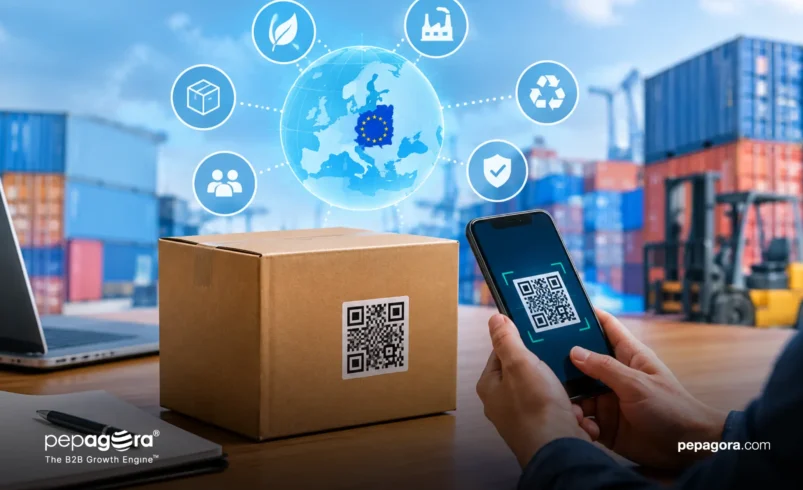

Product traceability is becoming an increasingly important part of global trade. Buyers, regulators and consumers want to know more about where products come from, what materials they contain, how they are made and what happens to them at the end of their useful life.
The European Union’s Digital Product Passport (DPP) is one of the major developments pushing this change. A DPP is a digital record containing relevant information about a product, its materials, sustainability characteristics, compliance and lifecycle. The EU is introducing the system progressively across selected product categories.
For Indian MSMEs supplying international markets, understanding DPPs early could become an important part of export readiness.
What Is a Digital Product Passport?
A Digital Product Passport acts like a digital identity for a product.
Depending on the product category and applicable rules, it may provide information about:
- Product identification and characteristics
- Materials and composition
- Origin
- Sustainability information
- Repair and maintenance
- Reuse and recycling
- Relevant economic operators
- Regulatory and conformity information
The information can be accessed through digital data carriers such as QR codes, depending on the applicable requirements.
The objective is to make product information easier to access and share across the value chain.
Why Should Indian MSMEs Pay Attention?
The DPP framework is particularly relevant to MSMEs that export to the European market or supply larger companies that do.
The EU’s current implementation plan covers product groups including textiles, iron and steel, aluminium, tyres, furniture, mattresses and certain ICT and energy-related products.
The timelines vary by category.
This means an Indian supplier may increasingly be asked by an overseas customer to provide structured information about the products or components it supplies.
The requirement may not always fall directly on the MSME. However, customers and larger supply-chain partners may need data from their suppliers to meet their own compliance obligations.
For MSMEs preparing for international markets, this also connects with the broader shift discussed in From Local to Global: First Steps for Indian MSMEs to Start Exporting.
Product Traceability Is Becoming a Business Capability
For MSMEs, the biggest change is not simply creating a QR code.
Businesses need reliable information behind that QR code.
This could require better records of raw materials, suppliers, production batches, certifications, testing, product specifications and sustainability-related information.
A business that currently stores this information across spreadsheets, emails and paper documents may need to gradually move towards more organised digital records.
This is part of the wider digitalisation push for SMEs as businesses increasingly adopt digital tools and systems.
How MSMEs Can Prepare
Identify What Data You Already Have
Start by mapping the information already collected during procurement, manufacturing and dispatch.
Identify where information is stored, who maintains it and whether it can be linked to specific products or batches.
Improve Supplier Data
Traceability does not stop at the factory gate.
If an MSME buys materials or components from other suppliers, it may need reliable information about those inputs. Building stronger supplier documentation can therefore become an important part of export readiness.
This also reflects the growing importance of global supply-chain changes for Indian manufacturers.
Digitise Product Records
Businesses do not necessarily need an expensive digital transformation project immediately.
They can begin by creating standard digital records for product specifications, batch numbers, materials, quality checks and certifications.
As requirements become clearer, these systems can be connected to more advanced product-data platforms.
Focus on Data Accuracy
A digital passport is useful only when the information behind it is reliable.
Businesses should establish clear responsibility for entering, checking and updating product information.
Data should also be protected because some product and supply-chain information may be commercially sensitive.
DPPs Could Create Opportunities, Not Just Compliance
Work
Better traceability can also improve business operations.
Reliable product data can help MSMEs respond faster to buyer queries, identify quality issues, track materials and demonstrate compliance.
The European Commission also highlights improved supply-chain performance, efficiency, quality and market opportunities as potential benefits of DPP implementation.
The EU’s DPP Registry became operational in July 2026, marking an important step toward implementation.
For businesses in sectors such as batteries, preparation is particularly immediate: certain battery categories are scheduled to require Digital Product Passports from 18 February 2027.
The wider move toward structured digital information is also reflected in how digital platforms are transforming B2B trade.
What MSMEs Should Do Now
Businesses exporting to the EU should monitor product-specific requirements rather than assuming that every product will have the same DPP obligations.
A practical starting point is to:
- Identify products likely to fall under future requirements
- Map existing product and supplier data
- Digitise important records
- Improve batch and material traceability
- Discuss data requirements with international buyers
- Monitor relevant EU regulations and standards
Digital Product Passports represent a broader shift toward data-driven product traceability in international trade. For Indian MSMEs, the change may initially appear like another compliance requirement, but it can also encourage better documentation, supply-chain visibility and operational efficiency.
Businesses that start organising their product data now can be better prepared as international buyers and regulations increasingly demand greater transparency across global value chains.
FAQs
A Digital Product Passport is a digital record containing relevant information about a product, such as its identification, materials, origin, sustainability information, repair or recycling details, and applicable regulatory information.
DPP requirements may affect Indian MSMEs that export products to the European market or supply components and products to larger companies that have EU compliance obligations. Preparing product and supplier data can help businesses respond to future information requirements.
MSMEs can start by identifying products that may fall under future requirements, organising product and supplier information, digitising important records, improving batch and material traceability, and discussing data requirements with international buyers.
