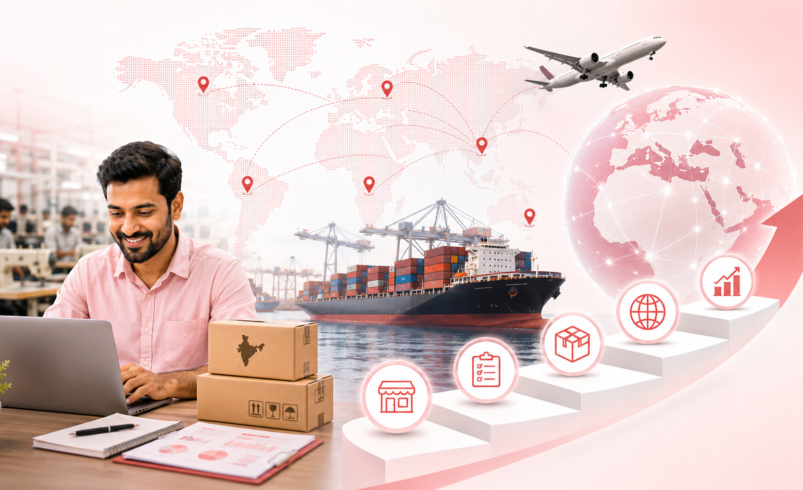

India’s export story is no longer being written only by large corporations. Across the country, thousands of Micro, Small, and Medium Enterprises (MSMEs) are entering international markets and finding customers far beyond their local districts and state boundaries.
From engineering components manufactured in Rajkot to handicrafts produced in Jaipur and food products processed in Coimbatore, Indian MSMEs are increasingly becoming part of global supply chains. The rise of digital B2B platforms, improved logistics infrastructure, and government initiatives aimed at boosting exports have significantly lowered the barriers to entering international markets.
Yet many business owners still believe exporting is complicated, expensive, or reserved for larger enterprises. In reality, the first steps toward exporting are often simpler than many entrepreneurs imagine. For Indian MSMEs looking to expand beyond domestic markets, understanding the fundamentals of export readiness can open new growth opportunities and diversify revenue streams.
Why More Indian MSMEs Are Looking Beyond Domestic Markets
India’s export ecosystem has expanded significantly over the past decade. Merchandise exports continue to play a major role in economic growth, while sectors such as engineering goods, chemicals, pharmaceuticals, textiles, processed foods, agricultural products, and industrial machinery are finding increasing demand globally.
Several factors are encouraging MSMEs to explore exports:
Access to larger customer bases
Higher revenue opportunities
Reduced dependence on local market conditions
Better utilization of production capacity
Opportunities for long-term business growth
Growing demand for Indian products worldwide
For many businesses, exporting is no longer an option reserved for the future; it is a vital strategy for long-term survival and scale. This shift highlights why SMEs remain the backbone of India’s economy, establishing cross-border trade as a primary driver of sustainable industrial development.
Step 1: Obtain an Importer Exporter Code (IEC)
The first and most important requirement for starting exports from India is obtaining an Importer Exporter Code (IEC). Issued by the Directorate General of Foreign Trade (DGFT), the IEC serves as a unique identification number for businesses involved in international trade. Without an IEC, a business generally cannot ship goods or receive export payments through authorized banking channels.
The application process has become entirely digital and typically requires:
PAN card of the business
Business address proof
Bank account details
Basic business registration documents
Many MSMEs can complete the registration process online within a relatively short timeframe. An IEC is not merely a regulatory requirement; it represents a business’s formal entry into international trade.
Step 2: Identify Products With Export Potential
Not every product that performs well domestically will automatically succeed internationally. Before entering export markets, businesses should evaluate:
Global demand trends
Competitor pricing
Quality and environmental standards
Packaging and labeling requirements
Import regulations in target countries
Successful exporters often begin by focusing on products where they possess clear advantages, such as competitive pricing, specialized technical expertise, superior raw material quality, unique regional craftsmanship, or manufacturing flexibility. Understanding market demand before investing heavily in export inventory significantly reduces operational risk.
Step 3: Research Target Markets
One common mistake among new exporters is trying to target too many countries simultaneously. Experienced export consultants recommend starting with just one or two test markets that exhibit strong, consistent demand for your specific product category.
Critical factors to evaluate include:
Market size and import volumes
Tariff and non-tariff barriers
Regulatory and compliance frameworks
Competitor presence and local pricing expectations
Currency stability and payment terms
Freight and logistics costs
Regions that continue to offer massive opportunities for Indian MSMEs include the Gulf Cooperation Council (GCC) countries, Southeast Asia, Africa, Europe, and North America. Each market presents its own unique opportunities and compliance requirements.
Step 4: Build a Professional Digital Presence
International buyers increasingly conduct supplier research online before ever initiating a phone call or an email inquiry. A professional digital presence has become non-negotiable for export success.
Global procurement teams typically look for:
A clear, structured company profile
A digitized product catalog with exact specifications
International quality certifications (ISO, CE, etc.)
Verified manufacturing and production capabilities
Documented export experience and contact credentials
Businesses that lack digital visibility will struggle to attract international inquiries, regardless of how superior their physical products are. Many progressive MSMEs use digital B2B sourcing platforms like Pepagora to build trust and immediately put their manufacturing capabilities in front of international buying networks.
Step 5: Find International Buyers
Finding reliable buyers is often the biggest psychological hurdle for first-time exporters. Fortunately, modern sourcing methodologies provide multiple channels to generate qualified leads:
Digital B2B Platforms
Online marketplace ecosystems allow global buyers and localized suppliers to discover each other efficiently without geographical constraints, driving continuous trade matching.
Trade Exhibitions
Industry-specific domestic and international trade fairs remain highly valuable for meeting buyers face-to-face, shaking hands, and showcasing physical product samples.
Export Promotion Councils (EPCs)
Organizations like EEPC, APEDA, and Texprocil provide invaluable market intelligence, subsidized exhibition stalls, and verified trade leads for specific sectors.
Industry Associations
Chambers of commerce and local industrial bodies frequently host international buyer-seller meets (BSMs) to facilitate direct business matchmaking.
The most successful exporters utilize a combination of these channels rather than relying entirely on a single source of lead acquisition.
Step 6: Understand Export Documentation
Exporting requires meticulous documentation that can feel overwhelming at first, but it quickly becomes structured routine with experience. Essential documents include:
Commercial Invoice and Packing List
Shipping Bill / Bill of Export
Bill of Lading (for sea freight) or Airway Bill (for air freight)
Certificate of Origin (often required for preferential tariff claims)
Marine Insurance Policy
Export Declarations and GR/SDF forms
Partnering with an experienced Customs House Agent (CHA) or third-party logistics (3PL) provider can greatly simplify this process for MSMEs during their early shipping cycles.
Step 7: Manage Foreign Currency Risks
One of the most overlooked aspects of international trade is foreign exchange risk. When an Indian exporter sells products internationally, transactions are usually denominated in foreign currencies such as the US Dollar (USD), Euro (EUR), British Pound (GBP), or UAE Dirham (AED).
Because currency exchange rates fluctuate constantly between the time an order is confirmed and when final payment hits the bank account, profit margins can be vulnerable. For instance, an unhedged strengthening of the Indian Rupee can suddenly shrink expected profits. To safeguard revenues, MSMEs should consult with their banking partners to understand risk mitigation tools like forward contracts and plan their pricing architectures carefully.
Step 8: Focus on Quality and Compliance
Global buyers value supply chain reliability above almost all else. When assessing a new supplier, they look closely at batch-to-batch consistency, strict adherence to technical parameters, robust industrial packaging, and on-time delivery performance.
In international trade, maintaining zero-defect production quality and stringent regulatory compliance is far more effective for securing long-term business than pursuing unsustainable, aggressive price undercutting.
Step 9: Build Export Relationships, Not Just Transactions
Successful exporting is rarely built on one-off, opportunistic transactions; the true value lies in cultivating multi-year commercial relationships. Global buyers prefer working with suppliers who exhibit transparent communication, proactive updates on shipment timelines, and institutional honesty. Many of India’s largest export houses started with tiny trial orders that grew into massive annual supply contracts based entirely on mutual trust.
Digital Trade Is Making Exporting Easier
The sweeping digitization of global sourcing has democratized the international trade arena. Previously, finding overseas buyers required massive capital investments, expensive international travel, or setting up physical offices abroad.
Today, small businesses can easily establish cross-border footprints. Utilizing robust B2B platforms allows businesses to participate seamlessly in global trade networks that were historically accessible only to multi-million dollar conglomerates. Exploring modern frameworks on how Indian SMEs can become export champions emphasizes that digital adaptation is the ultimate equalizer for localized manufacturing setups.
The Future of MSME Exports
India’s broader macroeconomic target of achieving USD 2 trillion in total exports by 2030 relies heavily on the performance of its micro, small, and medium enterprises. As global supply chains continue to diversify and search for alternative sourcing destinations, Indian manufacturing hubs are perfectly positioned to fill the gap. MSMEs that proactively invest in export readiness, online product visibility, standardized quality controls, and data-driven market research will lead the next wave of global trade growth.
Conclusion
The journey from a local manufacturer to a global exporter does not happen overnight, but it is more achievable today than at any other point in industrial history. By systematically obtaining an IEC, analyzing target markets, constructing a professional digital footprint, and learning to manage transactional documentation and currency risks, any ambitious enterprise can scale. Geography is no longer a barrier; with the right digital infrastructure and strategic preparation, your business can successfully reach global markets.

About Author
Harsha Varthan
Harsha is a highly respected B2B marketing expert who passionately helps sellers and buyers connect, grow their businesses online, and build strong global visibility. His expertise spans SEO, content marketing, lead generation, marketplace strategy, public relations, and result-driven digital growth planning, making him a trusted voice in the industry.