
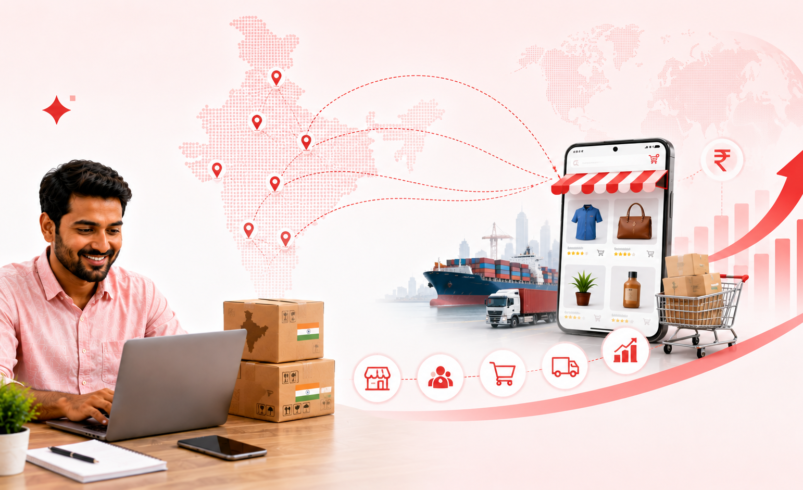

A quiet but powerful shift is reshaping India’s SME landscape. Businesses in Tier-2 and Tier-3 cities such as Indore, Coimbatore, Jaipur, Surat, Ludhiana, and Nagpur are no longer playing catch-up with metro-based competitors—they are actively competing and, in many categories, outperforming them.
The key driver behind this shift is not capital intensity or large-scale infrastructure. It is digital commerce adoption, especially through e-commerce marketplaces, D2C platforms, and B2B export networks that allow small businesses to scale nationally and globally without physical expansion. Recent insights highlight exactly how Indian small and medium enterprises are scaling to become export champions by utilizing decentralized digital supply chains.
Why Tier-2 and Tier-3 SMEs Are Suddenly Competitive
Traditionally, metro cities dominated due to proximity to buyers, logistics hubs, financial institutions, and trade ecosystems. However, three structural changes have reversed this advantage:
Expansion of affordable logistics networks (Delhivery, Shiprocket, India Post upgrades)
Rise of low-cost e-commerce marketplaces and B2B platforms
Digital payment systems enabling frictionless transactions
As a result, SMEs in smaller cities now operate on the same digital infrastructure as metro-based companies. This structural shift explains why SMEs remain the backbone of India’s economy, proving that business location is no longer a restriction to market penetration.
Case Example 1: Indore Textile Manufacturer Scaling Through E-Commerce
A mid-sized textile SME in Indore, originally supplying only to regional wholesalers, began listing its products on B2B and e-commerce platforms.
Key changes implemented:
Digitized product catalog with standardized SKUs
Listed on national marketplaces and export platforms
Used integrated logistics partners for pan-India shipping
Started accepting bulk orders online
Within 12–18 months:
Order volume increased beyond local capacity
60% of new customers came from outside Madhya Pradesh
Export inquiries began from Middle East buyers
The company successfully shifted from a regional supplier to a national B2B exporter.
Case Example 2: Coimbatore Engineering SME Winning Against Metro Suppliers
Coimbatore has long been an industrial hub, but small engineering component manufacturers are now competing directly with Delhi and Mumbai suppliers.
One SME leveraged:
Digital RFQ (Request for Quotation) platforms
Fast quotation turnaround systems
Strong specialization in niche machine components
Instead of relying on local distributors, they now:
Respond directly to buyer inquiries nationwide
Offer competitive pricing due to lower operational costs
Maintain faster delivery timelines than metro competitors
Result:
Increased OEM contracts from North India
Reduced dependency on intermediaries
Higher profit margins due to direct sales
Case Example 3: Jaipur Handicrafts Business Going Global
A Jaipur-based handicraft SME shifted from local tourism-based sales to global e-commerce platforms.
Strategy used:
High-quality product photography and digital branding
Listing on global marketplaces and export portals
Targeted digital ads for US and European buyers
Direct export fulfillment via logistics partners
Outcomes:
3x revenue growth in two years
Regular export orders from Europe and Gulf countries
Reduced dependency on seasonal domestic tourism
This demonstrates how traditional businesses can scale globally using digital tools.
The Real Competitive Advantage: Lower Cost + Digital Reach
Tier-2 and Tier-3 SMEs benefit from a structural cost advantage:
Lower labor costs
Lower rental and operational expenses
Strong local manufacturing ecosystems
Government incentives under MSME schemes
When combined with digital distribution channels, these advantages become extremely powerful. Metro competitors often face higher overheads, while smaller-city SMEs operate with greater flexibility and pricing competitiveness.
Role of E-Commerce and B2B Platforms in Scaling SMEs
Digital platforms are acting as equalizers by providing:
Instant access to national and global buyers
Standardized listing and discovery systems
Built-in trust mechanisms (ratings, verification, reviews)
Integrated logistics and payment systems
Lead generation without physical sales teams
Modern digital B2B platforms like Pepagora play a key role in this ecosystem, giving localized manufacturers direct visibility before global buying networks and closing the traditional infrastructure gap.
Key Success Factors Behind Winning SMEs
Successful Tier-2 and Tier-3 businesses typically share common traits:
Strong product specialization instead of diversification
Fast response time to buyer inquiries
Digital-first mindset in sales and marketing
Consistent product quality standards
Use of automation tools for cataloging and order management
These factors matter more than location or scale.
Challenges Still Facing Smaller City SMEs
Despite progress, challenges remain:
Limited digital marketing skills
Low awareness of global compliance requirements
Logistics coordination issues in remote areas
Trust barriers with international buyers
Underutilization of data-driven decision-making
However, these gaps are rapidly closing as platforms and service providers improve accessibility.
The Future: Distributed Manufacturing Advantage
India is moving toward a distributed manufacturing model, where production is no longer concentrated in metro cities. Instead:
Design, production, and distribution are geographically decentralized
Digital platforms connect fragmented supply networks
SMEs become direct participants in national and global supply chains
This shift is expected to significantly increase the contribution of Tier-2 and Tier-3 SMEs to India’s export economy.
Conclusion
The success of SMEs in cities like Indore, Coimbatore, and Jaipur demonstrates a clear trend: geography is no longer a limitation. Digital infrastructure has leveled the playing field, and in many cases, reduced operational costs give smaller-city businesses a real competitive edge. The winners in this new landscape are not the biggest companies, but the most digitally adaptive ones.

About Author
Harsha Varthan
Harsha is a highly respected B2B marketing expert who passionately helps sellers and buyers connect, grow their businesses online, and build strong global visibility. His expertise spans SEO, content marketing, lead generation, marketplace strategy, public relations, and result-driven digital growth planning, making him a trusted voice in the industry.