
Caption: Nirmala Sitharaman unveils the Union Budget 2026–27, highlighting raw materials and chemical sector support.
New Delhi, February 1, 2026 – In the Union Budget 2026–27 presented by Finance Minister Nirmala Sitharaman, the Indian government has earmarked a significant ₹32,914 Cr commitment toward strengthening the raw materials and chemicals ecosystem by signaling a strategic drive toward industrial self‑reliance, import reduction, and global competitiveness for manufacturers and MSMEs alike.
This allocation dovetails with a broader manufacturing push in Budget 2026 including semiconductor support, biopharma initiatives, export‑linked incentives, and customs rationalisation, all aimed at bolstering India’s supply chain resilience and export readiness.
Raw Materials & Chemicals: Strategic Pillars of Growth
Budget 2026 singles out raw materials and chemicals as foundational to sectors such as pharmaceuticals, specialty and industrial chemicals, renewable energy materials, EV batteries, and high‑tech manufacturing.
Key Initiatives announced
- Three Dedicated Chemical Parks: Financial and infrastructural support for chemical parks on a plug‑and‑play model to enhance manufacturing scale and reduce import dependency.
- Rare Earth Corridors: Development of rare earth and permanent magnet corridors in Odisha, Kerala, Andhra Pradesh, and Tamil Nadu — designed to secure critical minerals for high‑tech applications like batteries, electronics, and green energy. (Ref: Press Information Bureau Govt. of India)
- Customs & Duty Relief: Budget 2026 provides duty exemptions and reductions on capital goods, lithium compounds, and critical raw materials by lowering input costs for domestic producers, particularly in EV battery and chemical intermediate sectors.
- Incentives for Downstream Manufacturing: Tariff rationalisation on reactors, storage vessels, and certain imported raw materials increases competitiveness for Indian producers.
Smaller Industries to Benefit: SME & MSME Focus
Recognising that small and medium enterprises are vital to India’s industrial fabric, the Budget includes targeted provisions to boost capacity building, liquidity, and technology adoption:
Major MSME‑focused Measures
- ₹10,000 Cr SME Growth Fund — aimed at equity support, scale‑ups, and modernisation of enterprises across sectors including chemicals.
- Top‑up to Self‑Reliant India Fund (₹20,000 M) — enhances financial support available to micro and small units expanding into new markets.
- TReDS & Credit Support: Mandatory onboarding of CPSEs on the Trade Receivables Discounting System (TReDS), along with credit guarantee support for invoice discounting to free up working capital.
Liquidity, equity backing, and structured finance reforms are expected to ease cash‑flow pressures and support growth plans for MSMEs in chemical intermediates, process chemicals, and allied raw material manufacturing.
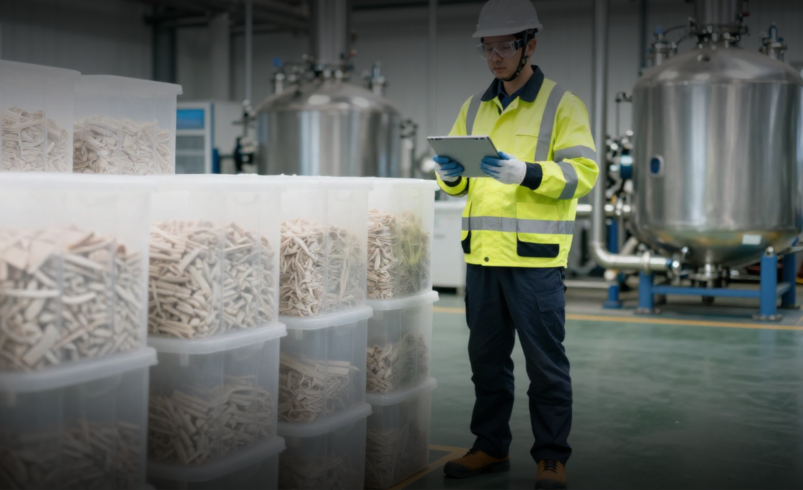
Caption: Proposed chemical parks and clusters to support SME integration and cost-efficient operations.
Green Transition & Advanced Manufacturing
Budget 2026 moves beyond traditional manufacturing to support sustainability and future‑tech sectors:
- Carbon Capture Utilisation & Storage (CCUS): A dedicated ₹20,000 Cr outlay has been announced to promote CCUS technologies — essential for decarbonising heavy industries including chemicals and refining. This aligns with India’s climate goals and supports innovation in emission reduction.
- Rare Earths & Battery Minerals: Exemptions on basic customs duty for lithium carbonate, lithium oxide, and lithium hydroxide — key raw materials for EV battery production are now proposed to be reduced to nil, enhancing local manufacturing prospects for battery‑related chemicals.
- Sustainable Production Incentives: With an impetus on green chemicals and renewable energy supply chains, Budget 2026 dovetails with national efforts to build an eco‑efficient, globally competitive manufacturing base.
Sectoral Impact Breakdown
Segment | Budget Drivers | Expected Benefits |
Industrial Chemicals | Chemical Parks + duty relief | Scale production; cost efficiency |
Specialty & Fine Chemicals | Growth Funds + export facilitation | Export competitiveness & quality compliance |
Rare Earth & Critical Minerals | Corridors + customs exemptions | Stable supply for advanced manufacturing |
Pharmaceutical Inputs & APIs | Import substitution incentives | Cost reduction + increased domestic sourcing |
EV & Battery Raw Materials | Lithium duty elimination + CCUS | Boost local battery materials ecosystem |
Export & Global Linkages Strengthened
Budget 2026 also enhances export readiness for Indian manufacturers:
- SEZ & Bonded Facility Support: Export‑oriented chemical producers benefit from duty remission schemes and streamlined compliance.
- Customs Modernisation: Faster customs clearance, longer advance ruling validity, and extended duty deferral windows for trusted manufacturers are now in place — reducing friction in cross‑border trade.
Expert & Industry Commentary
Industry leaders have broadly welcomed the focus on supply chain security and import substitution.
Experts note that reducing tariff barriers on key raw inputs and capital equipment, coupled with infrastructure‑level chemical parks, can shift India’s position from an import‑dependent market to an export‑competitive base over the coming decade.
However, analysts also underscore that effective implementation and scheme details such as eligibility criteria, route maps for accessing funds, and project timelines will be critical for MSMEs to fully capitalise on these announcements. Early operational guidelines are still awaited from government notifications.
Strategic Opportunities for MSMEs & Chemical Manufacturers
To fully leverage Budget 2026 advantages, firms should consider:
- Engaging with Chemical Park initiatives for access to shared services and enhanced logistics.
- Leveraging customs and duty exemptions on raw materials, capital equipment, and critical minerals.
- Accessing SME funding & liquidity programmes (SME Growth Fund, TReDS, Self‑Reliant India Fund).
- Investing in automation, quality control, and sustainability to meet export standards and green compliance.
Exploring new export channels via SEZs, bonded warehousing, and emerging duty remission schemes.

A Budget that Targets Supply Chain Strength, Sustainability & Competitiveness
Budget 2026 places India’s raw materials and chemicals sector at the core of its industrial agenda with a ₹32,914 Cr focus on infrastructure, finance, and competitiveness.
By supporting MSMEs, incentivising sustainable practices, and anchoring critical mineral supply chains, the government aims to transform India into a resilient and globally competitive manufacturing hub, aligned with Make in India and self‑reliance priorities.
For SMEs and MSMEs in the chemicals value chain, Budget 2026 is more than numbers, it’s a strategic opportunity to scale, innovate, and participate in global industrial ecosystems.