
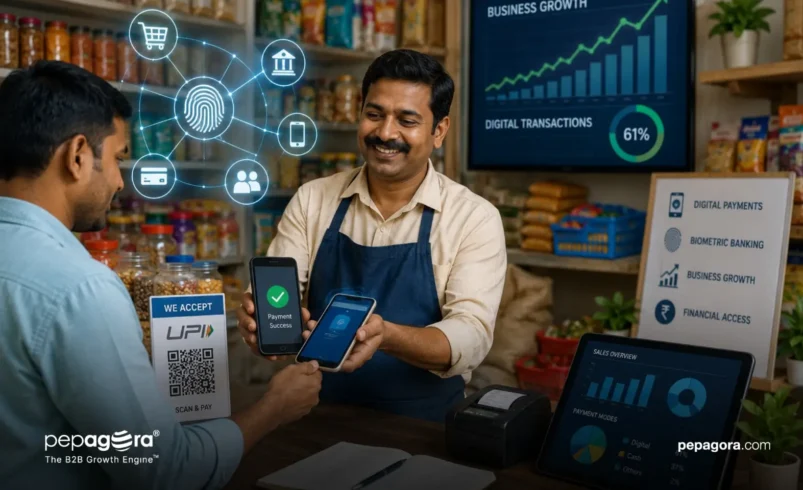

Small and medium-sized businesses are rapidly transforming their operations, moving confidently away from traditional cash-only setups into a robust digital ecosystem. According to a comprehensive new study tracking thousands of local retailers, small business owners are no longer merely experimenting with modern financial tools; they have integrated them into the core of their daily operations.
This macro shift is altering the traditional storefront landscape, proving that micro, small, and medium enterprises (MSMEs) are highly adaptive when backed by accessible digital trade channels.
For decades, neighborhood storefronts and independent merchants operated almost exclusively on cash. This heavy reliance on physical currency limited daily operational efficiency, created security vulnerabilities, and severely restricted access to formal institutional credit. Today, however, a massive technological wave is completely reshaping how these retail entities conduct business, manage inventory, and interface with their customer base.
The Modern Payment Dynamic: A Hybrid Marketplace
While cash remains a structural component for many daily shoppers, alternative payment methods have officially claimed the majority share of the market. This transition highlights a dramatic behavioral shift among consumers and merchants alike, driven entirely by the ease of instant transaction processing.
Payment Method Category | Total Market Share | Primary Use Cases & Context |
The Digital Lead (Mobile & Biometric) | 61% | Instant smartphone applications and fingerprint-authenticated digital banking workflows now represent the absolute baseline standard for store commerce. |
Traditional Cash Frameworks | 37% | Acts as a parallel mechanism that optimizes local economic velocity rather than vanishing entirely, pointing to a healthy hybrid system. |
Other Micro-Transactional Tools | 2% | Miscellaneous localized barter, token clearings, or digital ledger IOUs. |
When breaking down specific core financial services requested at local storefront hubs, cash withdrawals lead at 51%, followed by biometric digital banking at 22%, and mobile application payments at 12%. This distribution proves that small retail setups are increasingly stepping in to act as micro-banking centers for their local communities.
This intersection of biometric verification and instant smartphone applications provides a highly secure framework. By lowering the dependency on physical banking infrastructure, small business networks can process high volumes of micro-transactions seamlessly, minimizing the accounting errors traditionally associated with manual bookkeeping.
Surging Confidence and Revenue Impacts
Merchant psychological comfort with advanced applications has reached a vital milestone, ensuring long-term digital sustainability across regional commerce networks. Today’s business statistics point to an incredibly successful digital onboarding track:
- 87% of merchants state they feel notably more confident utilizing digital tools today than they did just 12 months ago.
- 82% report being entirely comfortable managing their core business activities through mobile software and dedicated B2B platform dashboards. Merchants are moving far beyond simple peer-to-peer apps to adopt sophisticated tracking ecosystems that manage sales logs and vendor payouts.
- 80% have observed a distinct rise in consumer demand for digital transaction options over the past year, creating a pull effect that requires traditional retailers to adopt digital payment infrastructure to maintain market share.
This transition extends far beyond mere administrative convenience—it is directly driving business viability. Notably, 41% of respondents reported that adopting these systems directly boosted their overall income, while 37% credited the technology with attracting entirely new customer segments to their shops. By accepting diverse digital payment methods, merchants eliminate friction at checkout, which frequently correlates with higher average transaction values and increased customer retention.
Emerging Interest in Micro-Retail Automation
Artificial Intelligence (AI) is also beginning to make early inroads into small neighborhood commerce. While widespread implementation is still in its infancy, curiosity among owners is remarkably high, paving the way for the next phase of the retail evolution.
90% of business owners are now aware of AI technology. This near-universal awareness indicates that high-level tech trends are successfully trickling down to grassroots commerce via digital media and peer networks.
Currently, 71% of merchants are already utilizing basic automated features to streamline routine tasks and optimize daily store operations. These features typically include automated ledger balances, smart inventory alerts, and predictable reorder reminders.
However, a learning curve remains, with 26% of owners admitting they are still determining which specific automated features would provide tangible benefits to their specific business models. For businesses wanting to maximize these systems, deploying targeted AI solutions for small retailers and factories helps bridge the technical knowledge gap. This transition from basic digital ledgers to sophisticated automation allows owners to unlock predictive analytics, smart dynamic pricing, and automated customer relationship tools.
The Long-Term Economic Vision: Credit Over Collateral
The structural transformation observed within the small business landscape signals a deeper economic evolution. When micro-entrepreneurs embrace financial technology, they build a verifiable financial history. In traditional setups, a lack of documented transaction trails often excluded smaller enterprises from obtaining formal credit lines, forcing them to rely on high-interest informal loans.
With 61% of store transactions moving through digital channels, banks and non-banking financial companies (NBFCs) can now leverage secure data architecture to assess a business’s creditworthiness accurately. Real-time cash flow analysis, transparent transaction logs, and digital tax trails are steadily replacing physical collateral as the criteria for securing enterprise loans.
Ultimately, this data layer allows businesses to transition from simple local operations into highly integrated nodes of the national digital economy. Establishing an optimized, trustworthy profile via an updated B2B marketplace in India combined with clear electronic payment tracking guarantees long-term growth and structural resilience in an increasingly modernized marketplace.