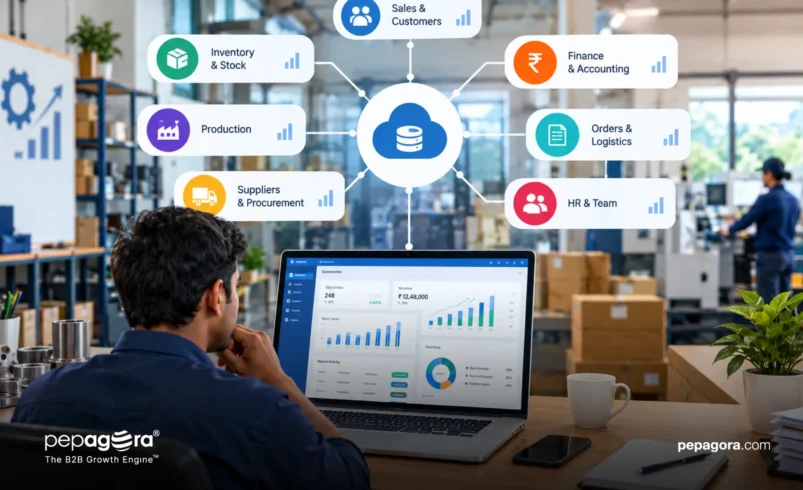

In the case of many MSMEs, business data may be spread across several different sources. For instance, sales teams might keep their customer data in spreadsheet files, accounting may have its own software that keeps data on financial matters, the inventory database might have data on the inventory maintained and all updates may come through emails and WhatsApp. Digital procurement can also involve information from multiple suppliers, orders, and purchasing processes that needs to remain connected.
Each one of these might work independently, but the challenge is that a business would find it difficult to gain the full picture of the business.
A unified business data helps to overcome this challenge by bringing together all the important data from various departments.
Unified Business Data Definition
The definition of unified business data involves the integration of data across various business functions to create a connected system through which data becomes accessible and analyzable. These may consist of:
- Customer and sales data
- Inventory and procurement data
- Finance data
- Supplier data
- Production data
- Operational and employee data
- Order and delivery data
However, the point is not always to store all the data in one place or database. Rather, companies can employ an integrated system through which data can flow across different departments.
How Inconsistent Data Causes Issues
Employees Deal with Separate Data
As departments keep their own databases, the same customer, order, or product will be treated differently in different databases.
One department will have up-to-date data while others will still use outdated data.
Management Will Get the Outdated Picture
The owner of the business needs to know what is going on with sales, finances, inventories, and operations of the company.
The problem is that employees will spend time gathering information manually and preparing reports. By the time the report is prepared, the data might become outdated.
Human Input of Data Can Cause Errors
When data is entered manually in spreadsheets and applications, there are chances that errors can be made.
This includes errors such as an incorrect product quantity, a customer update or an incorrect figure. These errors can impact business decisions.
How Connected Information Can Be of Help to MSMEs
Better Sales and Customer Management
When sales data is integrated with customer information, inventory information, and orders, salespeople have access to more comprehensive data.
For instance, before placing an order, a salesperson will be able to know whether there is any stock available and other information regarding the customer without consulting multiple departments.
Good Inventory Management
With the help of connected data, inventory management can become much easier for businesses.
Rather than discovering that the business does not have enough stock of a hot product through an order, the businesses can analyze trends using the connected data.
Increased Financial Transparency
Linking data between sales, billing and payments can increase the transparency of their finances and cash flows.
This will aid in determining overdue payments and improve financial planning.
Business Report Generation
When information is already linked, less time will be required by the staff to compile data for regular reports.
Managers can concentrate on analyzing trends and decision making instead of generating the same report again and again.
Technology Facilitation
ERP software, cloud-based programs, APIs, and digital public infrastructure can assist MSMEs in bringing all the information together from various business operations.
An MSME does not need to get rid of each system that already exists.
Based on its needs, it can link certain applications together to create an integrated data system.
This approach is especially helpful for MSMEs that are in the process of expanding.
Steps for How MSMEs Can Begin Developing Unified Data
Companies do not have to embark on big IT projects right away. Instead, they can begin by recognizing their key data flows.
Step 1: Determine Locations of Data
Document the various systems, spreadsheet and platform where the departments maintain their data.
Step 2: Look for Duplicate Data
Spot places where the same customers, products, suppliers or transactions are recorded multiple times.
Step 3: Determine High Priority Connections
Begin with those areas where disconnected data leads to significant bottlenecks like from sales to inventory or finance.
Step 4: Define Ownership of the Data
Figure out who is responsible for keeping critical data and frequency of its updates.
Step 5: Apply Analytics and Automation
After having structured the data, companies can use AI adoption and automation tools to extract even more value out of the data.
Unified Data – The Next Pillar for Business Growth
The bigger the MSME becomes, the more data it will have. As a result, more customers, products, suppliers, employees, and transactions will lead to data fragmentation.
A unified approach gives companies the ability to work with common data rather than having employees keep personal records.
Conclusion
Unified business information for MSMEs is more than just an IT improvement. It represents a method to achieve increased transparency throughout the company.
Through integration of data collected on sales, finance, stock levels, customers and processes within the company, MSMEs can save on manual labour, gain consistency and make decisions based on clear understanding of what is going on in the business.
The key here is quite straightforward – instead of collecting pieces of information from different departments, companies need to have access to the information integrated.
FAQs
Unified business data means connecting information from different business functions such as sales, inventory, finance, suppliers, production, orders, and delivery so that the information can be accessed and analyzed more consistently.
Connected data can provide better visibility into stock levels, orders, procurement, and customer demand. This can help MSMEs identify potential shortages or excess inventory earlier and support better procurement planning.
No. MSMEs can often connect selected existing applications using ERP systems, cloud-based software, APIs, or data integration tools. The approach can begin with high-priority data connections and expand gradually as requirements increase.