
Buying business-to-business (B2B) products has typically involved a number of steps including supplier identification, comparison of products, making inquiries about prices, specification examination, negotiation and purchase. Although digital platforms have facilitated these processes significantly, buyers still have to spend a lot of time switching from one website to another, one catalogue to another, email to email and spreadsheet to spreadsheet.
Agentic Commerce is likely to become one of the possible new developments in this field. Unlike the typical search functionality of online services, AI agents can potentially complete certain actions according to the predefined goals, preferences and criteria.
Such development is relevant for B2B companies since it can transform the way buyers identify and evaluate suppliers and make purchasing decisions.
What Is Agentic Commerce?
Agentic commerce can be defined as any form of commerce carried out using AI agents that comprehend objectives, make decisions based on certain parameters and undertake actions to achieve the objectives.
Traditional AI applications tend to be prompted individually. AI agents can, however, be designed to undertake a series of tasks.
In the above case, a person may state an objective as:
Identify packaging companies that fit our quality standards and budgetary requirements, as well as the time period within which they can supply.
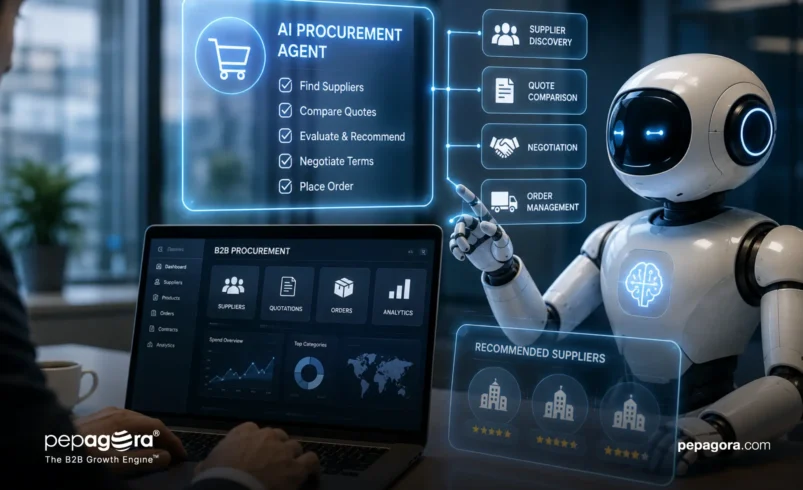
AI agents can then be able to identify the suppliers, analyze the relevant data, select suppliers, request for further information, and present recommendations.
The person will still have some say, especially in matters involving financial and strategic considerations.
Why Agentic Commerce Matters for B2B Buying
B2B procurement is often complicated since the decision-making process may have a number of criteria.
They might include:
- Specifications of products.
- Price.
- Order volume.
- Competences of suppliers.
- Certifications.
- Shipping times.
- Payment conditions.
- Location.
- Performance history of suppliers.
- Checking all this information manually may consume much time.
AI agents will be able to systematize this data and conduct routine research, so that procurement specialists can concentrate on relationships with suppliers.
How AI Agents Could Change Supplier Discovery
From Search to Delegation
In the modern world, the buyer uses keywords in a search engine or B2B platform and examines the outcome.
The use of the agentic system will mean that the buyer could explain his needs using natural language and the AI agent would do the search for relevant products.
Thus, the buyer would not just have the list of hundreds of outcomes, but the agent could even filter those by the buyer’s preferences.
Such an approach could lead to more efficiency in finding a supplier, especially if the buyer is searching across different platforms and markets.
More Personalized Recommendations
The AI agent could use the information about buyer preferences, purchasing history, budget and requirements to provide more targeted recommendations.
The buyer who wants to find an industrial product would get the recommendation not only by the keywords related to product, but also to the technical specifications, requirements to delivery and other factors.
Automated Supplier Evaluation
Supplier identification is the first part of the process. Next comes the determination of which supplier is fit for use.
AI agents can be helpful in this process by collecting data on the potential suppliers such as:
- Corporate profiles
- Catalogues
- Certification
- Reviews
- Prices
- Delivery
- Exportation
- Past dealings
The agent can compare this data with the preset requirements of the buyer and make a list.
But the buyer should not rely on AI evaluations blindly. Some data about the suppliers needs to be verified independently.
Faster Quotation and Comparison Processes
The process of asking for and comparing quotations may be among the most time-consuming parts of B2B purchasing.
An agent can talk to several suppliers, ask for necessary information, systematize answers, and produce comparative reports.
For instance, instead of inputting several quotations manually into a table according to price, delivery terms, conditions of payment, and so forth, a procurement department can use an AI agent to do that.
This could save time and automate the purchasing processes.
AI Agents Could Change Negotiations
Negotiations could also be influenced by agentic commerce.
Inside certain boundaries, an AI agent could possibly conduct some routine negotiations about:
- Delivery periods
- Order volumes
- Standards of prices
- Conditions of payment
- Shipping terms
For example, an organization could set the maximum price and period of delivery. Then, an AI agent would communicate with suppliers within these limits.
However, complicated negotiations concerning partnership or large contracts may still need the intervention of people.
The Rise of Autonomous Purchasing
One of the greatest opportunities offered by AI would be purchasing automation.
Firms could set the rules for procurement that would apply to recurring needs. Under certain conditions, the AI agent could find out the right vendors and take the next actions automatically.
So, for instance, a firm could program its procurement system to keep a certain amount of inventory. Once the inventory is down to a certain point, an AI agent could determine the right vendor and generate an order.
Benefits for B2B Buyers
Improved Efficiency
Artificial intelligence agents would take less time dealing with repetitive activities such as researching, comparison, and administration.
Faster Decision Making
Through organizing vast information from suppliers and products, artificial intelligence could assist buyers make faster choices.
Supplier Discovery
The agents would be able to look through a broader number of potential suppliers and find businesses which would be invisible to a buyer from his usual network.
Less Administration
Automation of routine tasks related to procurement would enable employees to concentrate on other more strategic activities.
Procurement Consistency
AI agents use predetermined criteria when analyzing suppliers’ information and thus ensure consistency of certain aspects of the purchase process.
What Agentic Commerce Could Mean for Sellers
The change will not impact buyers only; sellers will also have to adjust to an environment where intelligent agents will play a more prominent role in guiding the buying process.
Companies will have to ensure that their online data is understandable to AI systems.
This will involve ensuring accuracy in:
- Specifications of products.
- Pricing information.
- Business information.
- Availability information.
- Certificates.
- Delivery information.
- Conditions of ordering.
A company which has structured its online data may be in a better position to be detected and recommended by AI-based purchasing systems.
In this case, companies will have to become visible not only to human buyers but also to intelligent systems AI transforming buyer seller connections .
Challenges and Risks
Change does not affect only the buyers; the sellers too will need to adapt to the situation wherein intelligent agents will take center stage in guiding the buyers through the process.
The companies will need to make sure that their data on the Internet is readable to AI systems.
It means ensuring accuracy in the following:
- Specifications of products.
- Pricing details.
- Business details.
- Availability details.
- Certificates.
- Delivery details.
- Ordering conditions.
A company whose data is structured on the Internet may find itself in a better place to be spotted and recommended by AI-powered purchasing systems.
In this case, the companies will need to make themselves visible not only to human buyers but also to intelligent systems.
How Businesses Can Prepare for Agentic Commerce
Automation is not an immediate requirement for organizations. They can first try to figure out the process where AI can help them out.
The following steps may be taken:
- Convert all business and procurement related data into digital format.
- Standardize all information about products and suppliers.
- Determine the repetitive procurement process.
- Integrate AI tools in less risky processes.
- Set threshold limit for AI driven actions.
- Evaluate results generated by the AI agents.
- Keep human involvement in critical decision-making process.
Organizations need to keep in mind that AI agents are simply assisting tools for procurement process.
The Future of B2B Buying in 2026 and Beyond
The emergence of Agentic Commerce could transform B2B buying from search-based to goal-based.
As opposed to “which suppliers am I able to discover?”, business buyers would be asking AI systems, “identify the most suitable suppliers that satisfy these criteria.”
This difference could greatly transform digital procurement.
B2B marketplaces could start integrating AI agents that would have the capabilities of searching, comparing, communicating, recommending, and possibly transacting on behalf of businesses. Marketplaces could become smarter, whereas procurement solutions could become proactive. AI powered platforms for faster business matching
Nevertheless, trust would become crucial. Companies would require verification, data accuracy, secure systems, and transparent AI algorithms to enable autonomous purchasing.
In 2026, Agentic Commerce will revolutionize B2B purchasing in many ways because of its ability to make AI agents go beyond search and help and enable them to complete multi-step commercial tasks.
With supplier search, quotation comparison, purchasing recommendations, and negotiation, AI agents will save procurement professionals time on mundane tasks and improve the efficiency of their operations. Buyers will get benefits such as faster research and more personalized recommendations, but at the same time, sellers will have to pay extra attention to making sure their digital data is correct and complete. However, agentic commerce will not mean the end of human involvement in B2B transactions because of issues such as security, data accuracy, transparency, privacy, and financial controls that will still be extremely important.
Businesses that are likely to gain maximum advantage are those that will balance between automation and human involvement and prepare themselves to the future changes in B2B commerce by doing all the necessary groundwork. AI helping buyers and sellers connect faster
FAQs
Agentic commerce refers to the use of AI agents that can understand business objectives, evaluate information, make decisions based on predefined criteria, and complete multiple steps in a purchasing process.
AI agents can help buyers with supplier discovery, product comparison, quotation analysis, supplier evaluation, recommendations, and some routine procurement activities.
AI agents could handle routine negotiations within predefined limits, such as delivery periods, order volumes, pricing ranges, payment conditions, and shipping terms. Complex negotiations may still require human involvement.