
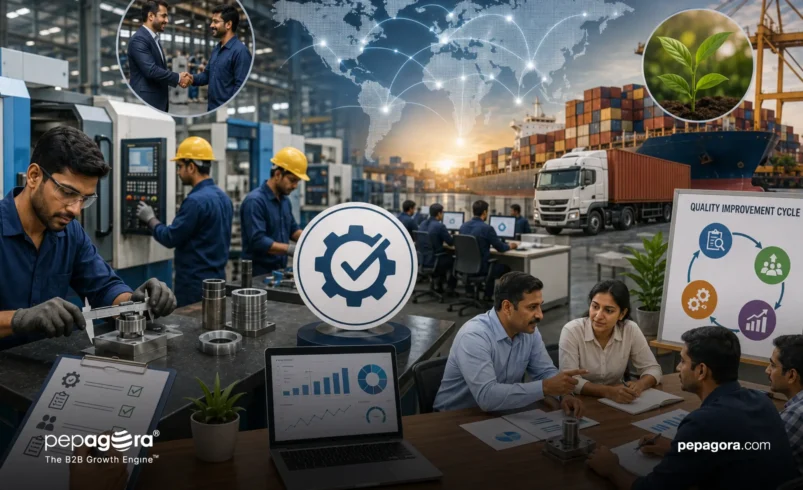

Ahead of the upcoming International MSME Day, a premier national non-profit institute dedicated to operational excellence has urged the creation of an extensive National Quality Mission. The proposed initiative is explicitly designed to integrate Micro, Small, and Medium Enterprises (MSMEs) into global value chains. By institutionalizing rigorous quality controls, advanced manufacturing standards, and standardized upskilling frameworks, the organization emphasizes that smaller enterprises can drastically reduce operational waste and position themselves as highly reliable partners for international buyers.
The call for structural reform arrives at a critical juncture for the domestic industrial sector. As the global market actively diversifies its sourcing networks, enhancing product reliability across the grassroots manufacturing tier is widely seen as the definitive key to unlocking long-term economic growth.
Bridging the Quality Gap in Small-Scale Manufacturing
For decades, the small business sector has been celebrated for its resourcefulness, adaptability, and high employment generation. However, when attempting to scale up operations and transition from domestic retail to international export markets, many small-scale manufacturers encounter a rigid roadblock: strict global quality compliance. International buyers operate under meticulous regulatory baselines, requiring flawless product consistency, precise traceability, and adherence to specific environmental and safety protocols.
Traditional independent factories often rely on legacy machinery and manual oversight, which naturally increases the probability of product variance and defects. When a shipment fails to meet international specifications, the resulting financial penalties, product rejections, and damaged reputations can devastate a small firm’s bottom line.
The proposed National Quality Mission looks to systematically eliminate this vulnerability. Rather than viewing quality checks as an expensive, final-stage administrative burden, the framework advocates for embedding total quality management principles directly into the daily operational workflow of small workshops. This systemic shift focuses on three core pillars:
- Zero-Defect Manufacturing Cultures: Training smaller teams to identify and rectify mechanical deviations in real-time, effectively stopping defects before products leave the assembly line.
- Standardized Quality Diagnostics: Providing affordable, localized access to certified testing labs, allowing merchants to validate their products against international benchmarks without absorbing massive overhead costs.
- Traceable Supply Chains: Utilizing basic digital tracking systems to document the origin of raw materials, giving global distributors complete visibility and confidence in the ethical integrity of the manufacturing process.
The Role of Regional Industrial Clusters in Global Trade
The structural transformation required to embed small businesses into global networks is heavily dependent on regional development. As detailed in the document “Tier 2 Cities Are Becoming Indias Next Business Growth Hubs“, the national economic landscape is experiencing a massive decentralization of industrial activity. Rapidly growing regional urban centers are fast becoming vital contributors to economic expansion, offering lower operational overheads, affordable industrial land, and highly skilled talent pools.
Many of these fast-growing regional hubs have already established highly specialized industrial clusters. For example, regional clusters are dominating textile production, engineering services, machinery manufacturing, and ceramics. Manufacturers and exporters operating out of these emerging urban centers are increasingly supplying high-quality products to global buyers across the Middle East, Europe, Africa, Southeast Asia, and North America.
Implementing a National Quality Mission across these specific emerging hubs creates a powerful multiplier effect. By connecting localized industrial clusters with standardized quality certifications, policymakers can supercharge grassroots manufacturing. Small-scale exporters in these emerging regions can gain the precise technical credibility needed to market their products worldwide, successfully competing against larger, well-established multinational corporations.
Accelerating Upskilling and Technological Adoption
To make a national quality framework genuinely viable for a micro-entrepreneur, the implementation strategy must prioritize user-friendly tech adoption and continuous upskilling. Industry experts suggest that the proposed mission should deploy mobile learning modules, peer-to-peer mentoring networks, and digital quality-assurance dashboards tailored for smaller setups.
By using simple software applications, business owners can easily digitize their inventory records, monitor machinery performance, and receive automated alerts for preventative maintenance. This baseline digitization serves a dual purpose: it automatically reduces factory downtime and generates a clean, transparent data trail. As explored in parallel economic initiatives, having a verifiable digital trail makes it significantly easier for institutional lenders to assess a merchant’s operational health, paving the way for collateral-free credit lines to fund advanced machinery upgrades.
The Multi-Trillion Dollar Incentive of Global Integration
Elevating the manufacturing standards of the small business sector is not just a localized industrial goal; it is a macroeconomic imperative. When thousands of small components manufacturers, textile weavers, and precision engineering shops achieve global quality benchmarks, the entire national economy becomes increasingly resilient.
Integrating into global value chains ensures a steady influx of international capital, insulates small businesses from domestic market fluctuations, and stimulates high-value employment opportunities in regional centers. By transforming the traditional manufacturing landscape into a faster, tech-enabled, and quality-driven ecosystem, the proposed National Quality Mission seeks to provide the long-term structural foundation required to elevate small business owners into powerful engines of international commerce.